The term 4WD can be a source of confusion and indicate that the forklift may be suited for all outdoor applications. However, a 2WD رافعة شوكية للطرق الوعرة can complete the same work in the yard and have less to service than the 4WD alternative. Areas with loose stone, wet soil or broken ground are where 4WD becomes a serious option for consideration.
Go for a walk around the area where you will be picking up and dropping off goods and note the surface type of the area where the forklift will start, stop, turn and idle with a load on it. One poor section of ground (such as a soft patch) at the loading area can make a big difference to a 2WD rough terrain forklift over 200 meters of good concrete.
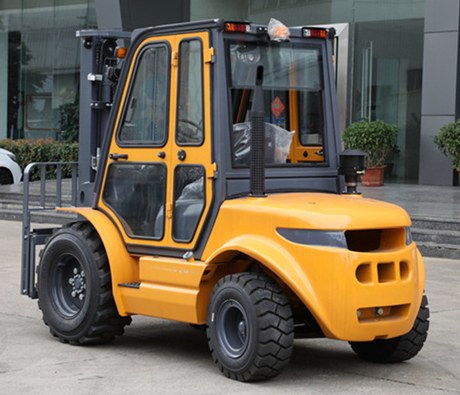
ALT: 2WD vs 4WD Rough Terrain Forklifts for Your Site
What 2WD and 4WD Actually Change
2WD typically means one axle is powered whereas 4WD systems distribute power to both axles. This is not to say that all 4WD systems function in the same way. Many continue to function in the same manner as a 2WD rough terrain forklift when not required whereas others can be switched on and off by the operator. In addition to the status of the drive wheels, the status of the differential locks and their operation must also be clarified. These are typically provided as separate controls and require specific operating procedures to be followed.
More driven wheels will provide the forklift with more opportunity to find traction but remember that increasing the number of driven wheels does not increase the maximum safe lifting height, does not reinforce weak ground and does not permit the forklift to travel any faster.
Start With the Worst Part of the Route
A clean concrete entrance does not describe the entire working route. Follow a loaded forklift through the worst part of the route and consider how it will operate after rain. A gravel ramp, braking on loose ground and a fill that ruts are all examples of where you need to think differently about forklift operation.
|
Working condition |
Question to ask |
Practical next step |
|---|---|---|
|
Dry concrete or maintained hardstand |
Is there wheelspin at starts or turns? |
Review 2WD first |
|
حصى مضغوط |
Does the top layer loosen or wash out? |
Test the loaded route in normal conditions |
|
Loose or uneven sections |
Does one axle regularly lose grip? |
Include 4WD in the comparison |
|
Deep mud or weak fill |
Can the ground carry the loaded truck? |
Repair or close the route first |
A 4WD forklift cannot cross ground that is too soft to support it. It may, however, make usable traction available at another axle when one begins to slip.
Firm Yards May Not Need Four-Wheel Drive
A truck working between a covered store and a paved loading apron may not require a 4WD model. However, the full route must be inspected. Check joints, ramps, corners, braking points and access to stacks. Take into account seasonal changes. A small pile of loose aggregate at a regular stopping point could impact a firm yard.
Loose Ground Gives 4WD a Clearer Job
A simple example for a collection point reached across a storage yard of loose aggregate such as crushed stone would be the front and rear axles of a vehicle not traveling on a solid surface. Even in good weather, such a surface can have poor grip after a period of heavy rain. Four-wheel drive could be beneficial in such circumstances by transferring useful traction from one under performing driven axle to another while the other axle starts to lose grip.
It’s also important to establish clear boundaries for the test prior to running it. The aim of the test is to ascertain whether a normal working day can be completed safely on the route in question, not to try to bury the truck in the worst sections of ground. Use a representative load, a suitable test vehicle and approved route, and withdraw the test should the ground fail beneath the wheels in any part of the circuit.
Tire Choice Can Reverse the Expected Result
The tire is the truck’s contact with the ground. Tread, construction, inflation pressure, wear and damage all change the available grip, whatever drive system is fitted.
Also include the intended tire specification on both quotes. Compare the required cold tire pressure, the required reserve of tires, the allowed degree of wear and the rules for mixed tires (of different wear) on both quotes. Different rolling circumferences can also cause problems with some types of drive.
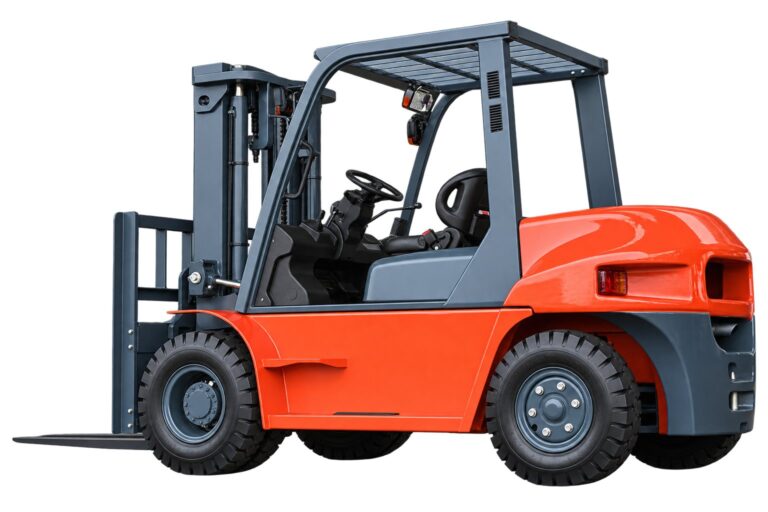
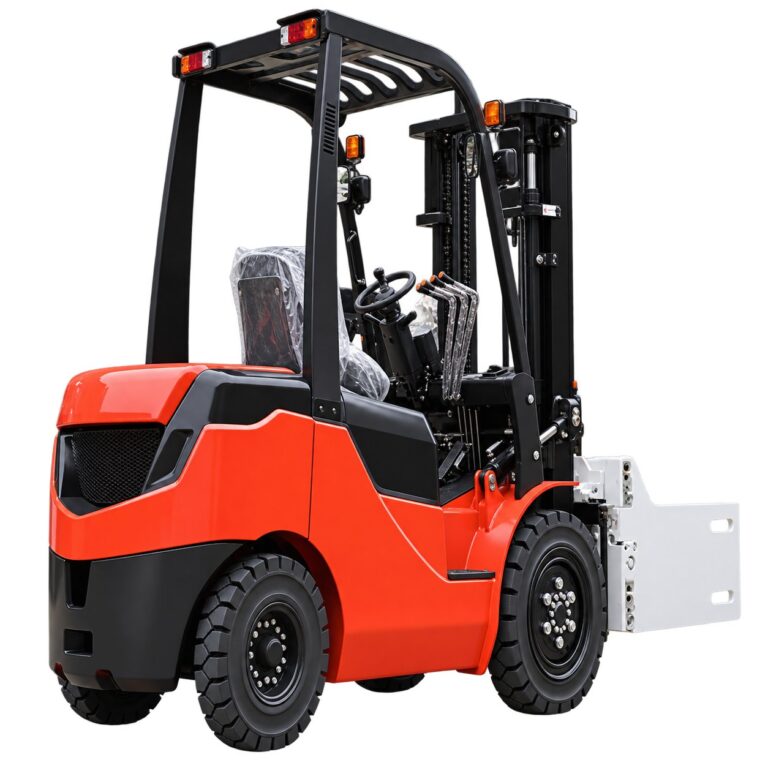
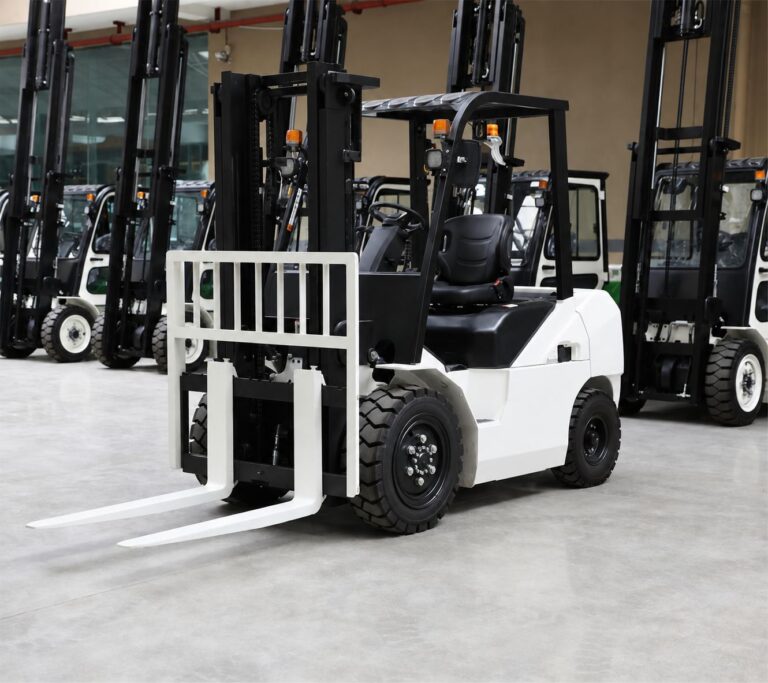
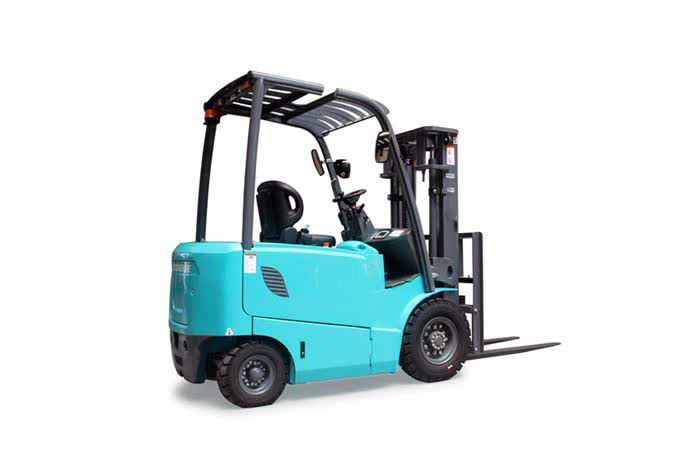
The broader forklift product range can help with equipment comparison, but a product photograph cannot settle tire suitability. Close-up photographs of loose, wet, or damaged sections are more useful when they are sent with the proposed load, route, and duty details.
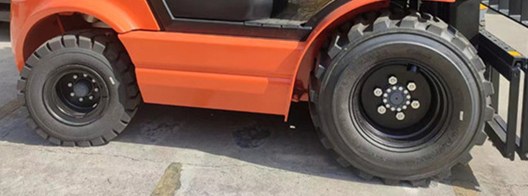
ALT: Rough terrain forklift tires and chassis for route assessment
Four-Wheel Drive Is Not Four-Wheel Steering
The terms “Drive” and “Steering” refer to two separate systems on a vehicle. The “Drive” system refers to the number of wheels that are powered. The “Steering” system refers to the number of wheels that are steered. Ensure that both systems are clearly noted on the dimensional drawing of the truck and its loads.
The issue of steering and turning when loading, such as onto a stockpile, is a separate matter from that of drive, and may result in the body of the truck turning a corner whilst the rear of the truck swings out to hit a barrier. Again the long load will result in a greater swept area than a shorter one and so again special provision will need to be made for access. This is covered in the access assessment and includes matters such as turning radius, amount of rear swing, maximum steering angles and load overhang.
The operating rules for the different drive modes must be clearly defined for a vehicle with a selectable drive system. This applies particularly for the usage on high friction surfaces and for turns. In this respect, reference must be made to the operating instructions for the drivetrain offered.
Treat Stopping and Stability as Separate Checks
Tread traction is one aspect that enables a vehicle to move but there are many factors that affect a vehicle’s stopping power including tire friction, speed, surface type, grade, brake type and vehicle mass.
However, the increased capacity of the truck (as shown on its plate) is NOT increased by a 4-wheel drive system. Attachments, longer load centers, higher loads etc. must still be within the limits for that specific truck and the 4-wheel drive system must still be operated within the restrictions for that specific truck. The load must be traveling in the same specified direction and orientation on the truck as was used for the demonstration of the specific truck’s capacity.
Put a Price on the Real Delay
Adding cost of 4WD is worth more than adding same cost to non-productive time. Say 4-wheel drive prevents 4 trips of 10 minutes each to recover from wheelspin over same distance. That is 40 minutes of lost time per shift, equal to 880 minutes over 22 shifts of work. The calculation must identify the cause(s) of the lost time. It could be poor grip, blocked access or a bad route that becomes worse after rain. Draining, grading or re-routing unloading could be more valuable than extra driven axle.
In addition to running costs of the drivetrain, also query the ownership costs for service items of the driven axles and the transfer case, required maintenance and parts support. In contrast to the running costs for fuel, here only compare the costs on corresponding loads and work cycles.
Make the Site Trial Worthwhile
It is also important to carry out a complete test drive of the entire job, i.e. empty approach to the loading point, picking up a load, traveling with a loaded truck around corners etc. Stopping, placing and returning to a parked position also need to be tested. All this is done with the same axle load and with the same grip as it will be when the truck is used in real working hours.
• State maximum load mass, dimensions, lift height, and attachment.
• Mark gradients, turns, surface transitions, loose areas, and stopping points.
• Record trip distance, trips per shift, and seasonal restrictions.
• Request tire details, drive controls, service intervals, and operating limits.
Submit a copy of the site plan with the load information through the equipment inquiry page. Request written confirmation of the quoted configuration. Photos are acceptable but site measurements and working conditions are far more informative.
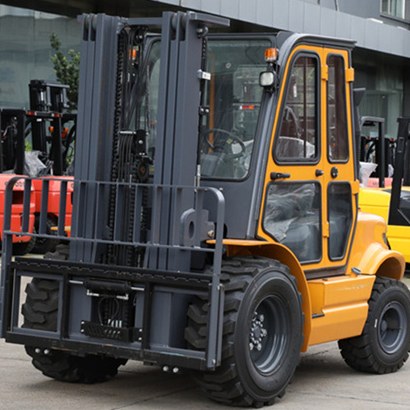
ALT: Rough terrain forklift configuration for outdoor handling
حول رافعة شوكية JinChengYu
Qingdao JinChengYu Machinery Co., Ltd. supplies material-handling equipment and related parts to overseas buyers. Its company also includes sales, after-sales, and rental services. Rough terrain forklifts are among the products supplied by the firm, and the company’s web site allows buyers to input information regarding the proposed route and the load to be moved. Written confirmation of the quoted forklift’s configuration and its limits can then be requested.
خاتمة
Initially determine at which point during normal use a truck would lose traction. On a regularly used firm route then a 2WD truck would be suitable. On mixed or weak surfaces however repeat loss of traction may support the choice with a 4WD truck. Check tires, ground strength, steering, braking, overall stability and maintenance needs separately for 2WD and 4WD.
الأسئلة الشائعة
These questions cover points that often arise after a site survey separates traction problems from weak ground and tight access.
Is a 4WD Rough Terrain Forklift Always Better Than 2WD?
No, a 4WD Rough Terrain Forklift is not necessarily better than a 2WD version. On firm routes and without loss of traction, a 2WD fork lift may provide extra service work with little increase in operating performance.
Can a 2WD Rough Terrain Forklift Work on Gravel?
It can work on firm gravel surfaces within the forklift’s specified operating conditions. Note that gravel surfaces can break up and create poor traction on the surface.
Does 4WD Increase Forklift Lifting Capacity?
No, the rated load is dependent on the load centre and lifting conditions for the given configuration of the truck. Four wheel drive will add no value if the attachment, load centre or lifting height is too great for the truck.
Is Four-Wheel Drive the Same as Four-Wheel Steering?
This question is often mixed up with the question of 4-wheel steering. Here again, drive and steering have to be distinguished from each other. The question of steering should also be sent to the sales company with the inquiry regarding the driven truck. The information regarding the turning circle for the truck with load must also be noted.
What Should a Buyer Send With a 2WD vs 4WD Inquiry?
This information will help specify the forklift accurately. The supplier needs the load dimensions and weight, lift height, route, gradients, and surface photographs. Operating frequency and typical seasonal conditions are also useful.