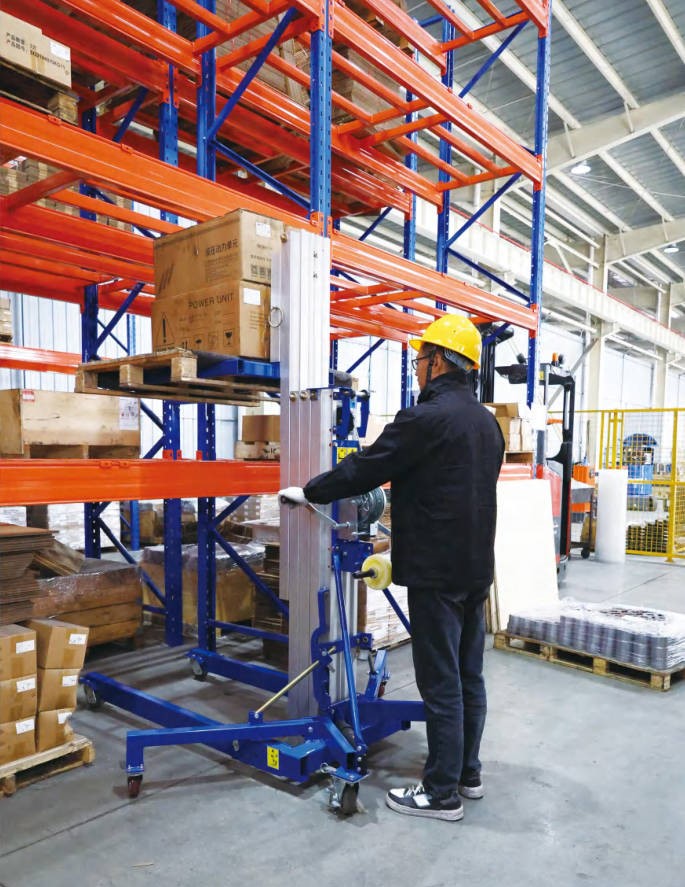
Time is money and for a small crew an overhead installation that requires a load to be held steady can waste half a day. Air handling ducts are rigid and like to bend in the wrong place, cable tray can swing and lighting framing has to be installed square and true. Small compact AC units can also prove to be a problem when installed overhead of a technician as they are generally too heavy to hold safely above shoulder height. A one person material lift enables a technician to safely raise and position loads in a controlled manner. This piece of practical equipment is perfect for HVAC contractors, electricians, warehouse workers, event workers and general fit out contractors alike. The material lift is an ideal solution for safe overhead material handling in confined spaces where there is limited labor, space is at a premium and time is of the essence.
Why Small Crews Struggle With Overhead Installation
Small teams do not have reserve workers to complete tasks that require extra help. The one person that unloads the truck is also the same person that moves tools around, takes the measurements for the opening, lifts the material, fastens the material and cleans up the area. When a job requires 3 people but only has 1 or 2, safety is compromised for the sake of the schedule.
Labor gaps create risky work habits
Ceiling duct work can be held by one person while another looks for screws to attach sections together. A technician may lift a unit heater up from a ladder as a forklift cannot reach into that particular aisle in a warehouse. Lighting frames for retail renovation pass through narrow doors to be lifted into the completed ceiling. These seemingly simple jobs actually consist of holding weight at height for a period of time to align the object.
A lift changes the role of the worker
A manual material lift transfers weight, but the worker controls direction, height and placement. For example, while a powered lift could raise a load to height in seconds, in small steps a manual lift can be raised to height in a more controlled and safe manner, stopped to check alignment, then moved to complete the one-person task efficiently.
Material Lift vs Manual Lifting
Manual lifting is very fast when lifting light objects but becomes extremely labor intensive when lifting bulky, unbalanced, sharp edged or overhead items. A material lift or other type of lift vs. manual lifting is determined by the load, room and finish quality.
Where manual lifting breaks down
While back strain is the major problem for workers installing HVAC systems, pinched fingers, unexpected load shift, dropped parts, and loss of ladder balance are other issues that need to be addressed. Long, thin ducts, metal frames, panels, and pipes are light but difficult to handle because of their shape. When a worker is required to twist, reach or look up while holding the load, error is likely to occur.
Why controlled lifting works better
A manual winch material lift is a type of aerial lift that raises the load up a mast as opposed to up through the worker’s arms. This style of lift has the load centered on the forks of the lift, the platform of the lift or even a pipe cradle. The operator can stand on the floor with their feet while lifting materials. Manual material lifts are often used in place of ladders for lifting materials, particularly for indoor work where larger equipment will not fit.
Common Jobs for a One-Person Material Lift
One person material lift is useful for many trades. With the correct attachment and lifting capacity, one person material lift can support HVAC, electrical, warehouse and indoor installation work.
| Jobsite task | Carga típica | Why the lift helps |
| HVAC duct installation | Duct sections, vents, AC units | Holds wide parts steady near ceiling level |
| Electrical installation | Cable trays, lights, panels | Helps with alignment before fastening |
| Warehouse maintenance | Heaters, parts, rack components | Works in aisles where large equipment may not fit |
| Event setup | Truss, speakers, screens | Raises gear smoothly in finished spaces |
HVAC and ductwork
A portable material lift can be used by HVAC crews as an HVAC duct installation lift or duct jack. It can be used to raise rectangular duct sections, round pipe, other ventilation parts and even compact air conditioning units. Instead of two people holding up a section of ductwork while a third person secures it in place, the lift holds the material for you. This is especially useful in shopping centers, workshops, offices and crowded mechanical rooms.
Electrical, lighting, and warehouse work
A electrician would typically lift cable trays, conduit, transformers, and large lighting fixtures in environments around racking, sprinkler lines, and ceiling grids. A warehouse would typically position parts on Mezzanine or service equipment above floor level. In both cases, solid positioning is more important than lift speed.
Safety Rules for One-Person Operation
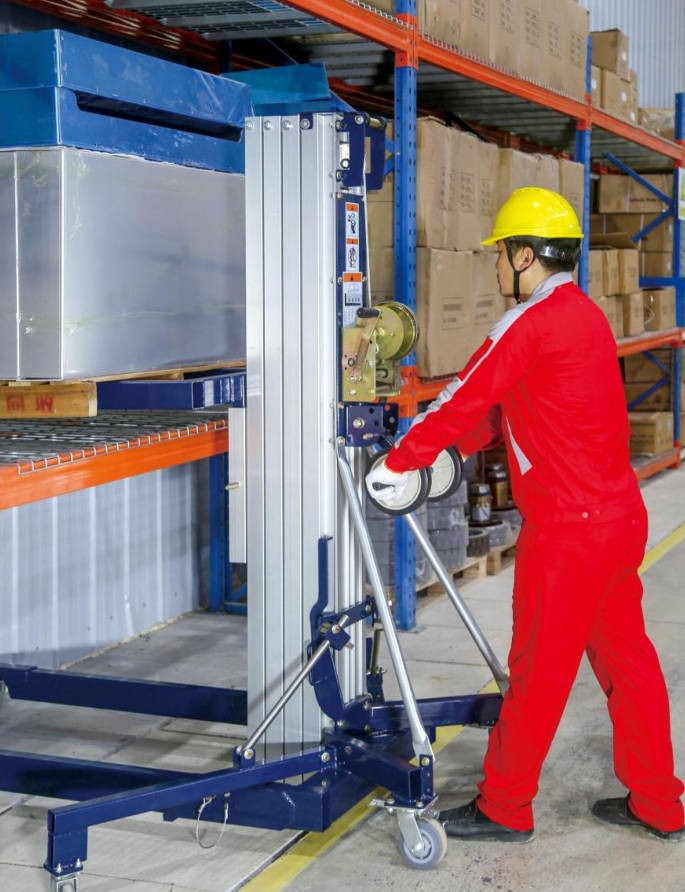
Working alone doesn’t mean working without thought. Although the lift is making the work easier for the operator, he will still need to plan each lift and before he commences to check the area, the load and the plant.
Start with the load
Just because something weighs less than the rated capacity of a lift does not mean it can be lifted as a long, thin, unbalanced shape with poor attachments. A 1000 lb material lift is still a 1000 lb material lift. A small box will be easier to lift than a long piece of duct of the same weight. Items that can roll, swing or slide during lift must be tied down or lifted with a better means of attachment.
Check the ground and the path
The lift should stand on level, firm ground. Wheels, stabilizers, mast sections, cable, winch, forks, and brakes need a quick check before work starts. The travel path should be clear. Raised loads should not be pushed across the floor unless the manufacturer permits it and the load is lowered to the proper travel position.
Use a simple checklist
- Confirm weight, size, and center of gravity.
- Choose forks, pipe cradle, or load platform.
- Lock the wheels or stabilizers as required.
- Keep hands away from pinch points.
- Raise the load slowly and stop if it shifts.
- Never stand under a raised load.
- Lower the load fully before moving or storing the lift.
Choosing a Portable Material Lift
A portable lift for indoor installation should match the site not just the heaviest item. Small contractors need portable lift equipment that can travel to the work, go through doors and set up quickly.
Capacity and height
The rated capacity of a lift needs to be checked against the lift height to see how load balance and mast stability are affected as height is increased. For applications such as overhead pipe work, duct work, stage equipment and warehouse components the lift’s ‘useful working area’ will enable the user to position the load at the fastener position with the base of the lift remaining within a stable working area.
Doorway access and transport
While performing indoor construction work, such as hanging drywall from the ceiling or finishing ceiling tile, it is useful to have a compact aluminum material lift. This type of material lift is useful if it can be tilted, rolled, stored upright and easily moved in a pickup truck or service van to the job site. The easier the lift is to bring to the job, the more it will be used.
Attachments matter
Forks are great for boxes and other “framed” loads. Pipe cradles are best for round items. Load platforms are the way to go for irregularly shaped loads. The attachment should provide solid contact with the load and not just enough surface to keep it balanced for a short time.
JinChengYu FORKLIFT as a Supplier
When choosing a supplier, you are not buying just the first item. A small crew needs a lift, guidance on the product, good communication and support on the jobsite. CARRETILLA ELEVADORA JinChengYu is a Qingdao-based supplier of overseas material handling, warehouse equipment and ground support equipment. They supply forklifts, aerial work platforms, warehouse handling equipment, attachments, spare parts and also portable aluminum material lifts.
JinChengYu’s expertise as a portable aluminum material lift supplier lies in manual winch lifting, aluminum alloy mast construction, non-powered operation, and various attachments to ducts, pipes, AC units, beams, panels, and even stage equipment. As a useful set of questions for buyers who are comparing one-person material lifts, it would be: 1. What height do you need the lift to reach? 2. What is the actual weight of the load that you intend to lift with the material lift? 3. Will the lift go through doorways on the job site? 4. What material attachment do you need for your lift? 5. Can the supplier provide you with the correct lift for your job, or are they just quoting a price?
Conclusión
Straining your back, using rickety ladders, and waiting for extra help to arrive to hoist overhead parts can be a thing of the past. A single person can now lift and position materials as needed with a one-person material lift. The various types of lifts can be used by HVAC technicians putting up ductwork, by electricians placing cable trays and lights, by warehouse staff handling overhead parts, and by event staff constructing finished spaces and lifting equipment as needed. The trick is to match the material lift to the job at hand, get a good read on the job site, and lift the materials safely. Contractors, dealers, and facilities people looking for a portable material lift for indoor overhead work over head will find the equipment they need and project support at JinChengYu FORKLIFT.
Preguntas frecuentes
Can one person operate a material lift safely?
Yes. As long as the load is rated, on a level floor, using the correct attachment, and operating the equipment in accordance with the manufacturer’s instructions then one person should be sufficient to handle a heavy load. However, a very heavy, very unstable or very oversized load could require additional personnel.
What can a one-person material lift be used for?
Ducts, AC units, cable trays, lighting fixtures, pipes, panels, warehouse components, event gear and many other objects and materials that require to be moved to a higher position in the air are lifted with this fork.
Is a manual winch material lift better than powered lifting?
This type of lifting is jobsite dependent. For certain jobsites a manual winch is ideal as power may not be available, there may not be a place to charge, or even a simple non-powered lift for moving materials is required for jobs that are done indoors or traveling from jobsite to jobsite.
How do small crews choose the right lift?
You should check load capacity, lift height, load center, door width, floor type, how you will transport the lift, and what type of attachments you will need. The best material lift for overhead work is the one that can do your real jobsite justice.