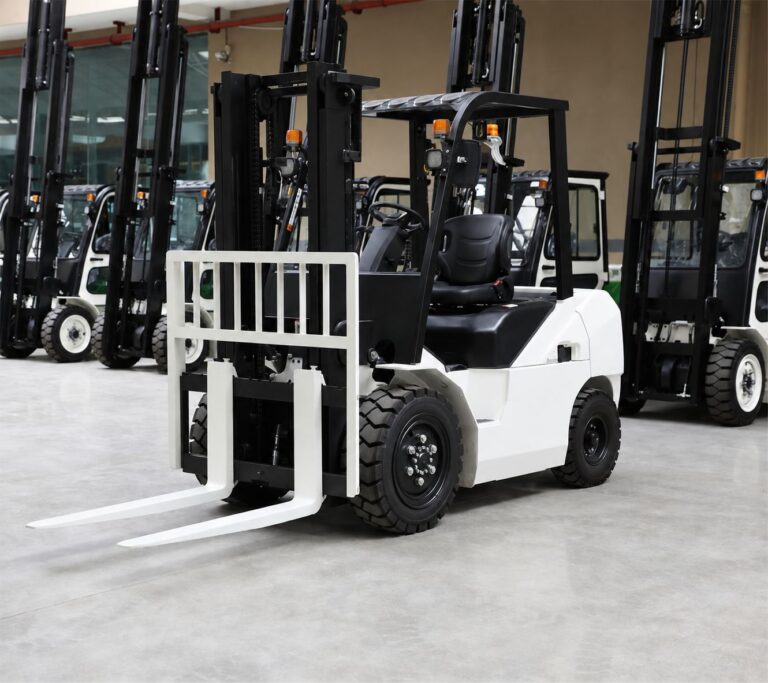
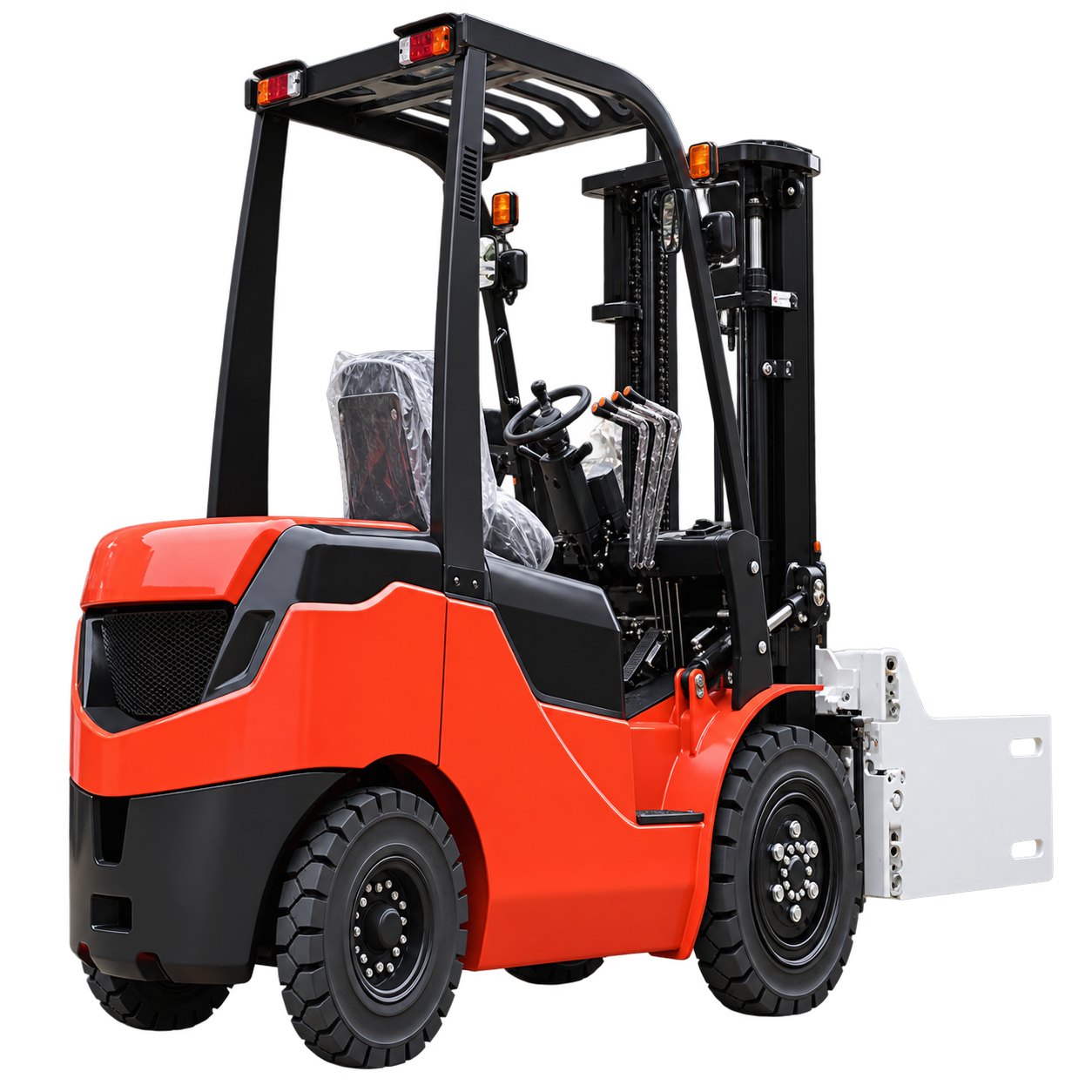
Alt:Forklift Aisle Width Measure Before You Buy
Forklift aisle width is the clear space a truck needs to approach a pallet, turn, pick or place the load, and leave without striking racks or nearby stock. A brochure dimension alone cannot settle the question. The truck, pallet, fork position, rack face, turning path, and a practical safety margin all affect the space required.
For a warehouse buyer, the useful question is not “How narrow is the truck?” It is “Can this truck complete the real pallet movement in the narrowest working aisle?” That distinction prevents an expensive machine from becoming slow, awkward, or unusable after delivery. Buyers comparing складское погрузочно-разгрузочное оборудование should measure the site before asking for a quotation.
What Forklift Aisle Width Really Means
Forklift aisle width usually refers to the right-angle stacking aisle, often shown as Ast on a specification sheet. It is the width needed for a truck carrying a stated load to turn 90 degrees and place that load into a rack opening. It is different from the truck’s overall width and different from its turning radius.
A 1.1 m wide truck may still need well over 3 m to stack a 1.2 m long pallet. The rear counterweight swings outward during the turn, while the pallet corners trace a different path at the front. The operator also needs room to correct alignment rather than making a perfect single movement every time.
Measurements to Take Before Comparing Forklifts
Start with the building, not the catalog. Measure the narrowest aisle at floor level and at the height where loads or rack protectors project into the route. Repeat the measurement near columns, fire equipment, door frames, and damaged rack uprights. A nominal 3.5 m aisle can lose 100 mm or more where guards or stored goods extend beyond the rack face.
The following dimensions give a supplier enough information to make a first assessment:
• Clear distance between the nearest fixed rack faces
• Pallet length and width, including any product overhang
• Forklift turning radius and distance from the front axle to the fork face
• Required operating clearance for rack protection and steering corrections
• Narrowest doorway, cross-aisle, and staging area on the route
• Maximum load weight and highest rack beam used in daily work
Measurements should use the largest normal load, not the neatest pallet in the warehouse. A pallet listed as 1,200 mm long may become 1,280 mm after cartons shift or stretch wrap bulges. That extra 80 mm follows the pallet through every turn.
How to Estimate a Right-Angle Stacking Aisle
A quick planning estimate adds the truck’s turning requirement, load length, front overhang geometry, and a working allowance. Exact formulas vary by truck design, so the supplier’s Ast figure remains the main reference. Even so, a site calculation is useful for screening unsuitable choices before detailed confirmation.
For example, suppose an existing aisle measures 3,500 mm between rack faces. The planned truck requires 3,250 mm with the stated pallet. On paper, 250 mm remains. That is only 125 mm per side if the truck and load are centered. A projecting pallet board, damaged rack protector, or slightly diagonal approach could use most of that space.
This is why the smallest published number should not automatically win. A truck that technically fits but needs repeated forward-and-reverse corrections can slow every pallet movement.
Turning Radius Is Only One Part of the Answer
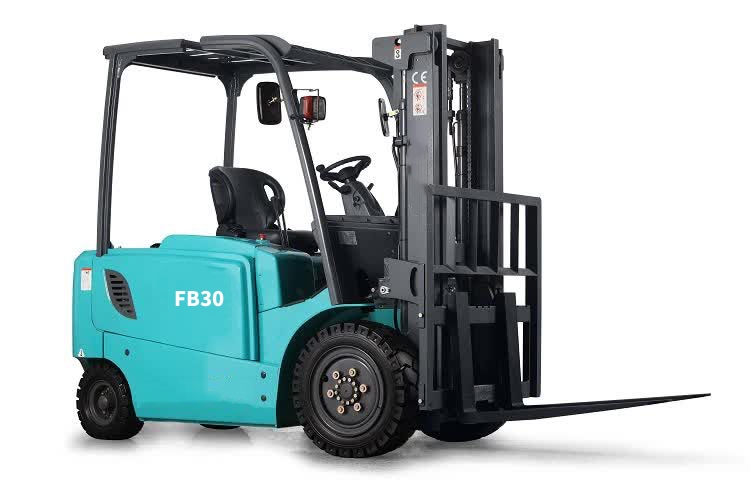
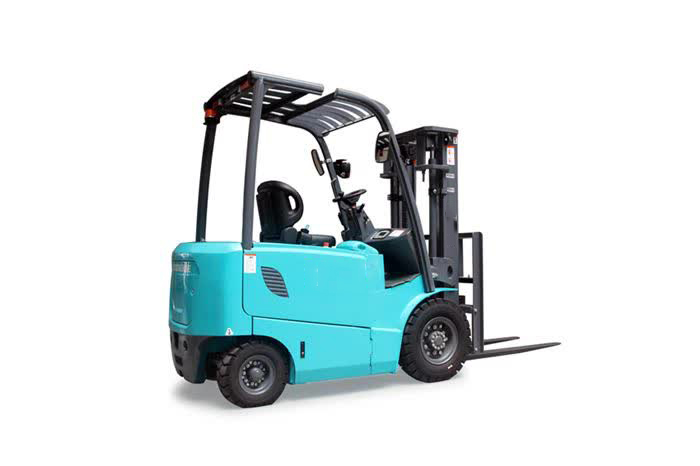
Alt:3-3.5T E series lithium battery eletric forklift
Turning radius describes the circle made by a stated point on the truck. A stacking movement adds the pallet, fork length, front overhang, and the changing angle between truck and rack. Two forklifts with similar turning radii can therefore have different right-angle stacking aisle requirements.
Rear swing deserves special attention with counterbalance trucks. When the operator turns toward a rack opening, the counterweight moves in the opposite direction. A wall, column, pedestrian barrier, or parked pallet behind the truck can block the turn even when the front looks clear.
Buyers reviewing an электрический вилочный погрузчик for indoor work should compare the full dimension sheet, not only overall width. Wheelbase, steering layout, mast position, and chassis length shape the real path through the aisle.
Match the Truck Type to the Warehouse Layout
Different truck designs use space in different ways. The right choice depends on where pallets begin, where they are placed, and how often the operator must turn or reverse.
Counterbalance Forklifts
Counterbalance forklifts are flexible around docks, production lines, yards, and mixed indoor routes. Their rear counterweight and chassis length generally require more stacking space than a warehouse truck designed for narrow aisles. They suit sites where one machine must unload a vehicle, cross open floor, and serve racks.
Reach Trucks
Reach trucks keep the chassis more compact and extend the mast or fork carriage toward the rack. They can work in narrower aisles and at greater rack heights, but they need suitable floors and planned warehouse routes. Dock plates, rough yards, steep transitions, and broken concrete may fall outside the job they do best.
Stackers and Pallet Trucks
Powered stackers can fit lighter work, lower throughput, and smaller storage areas. Pallet trucks move loads horizontally but do not replace a stacking truck where pallets must reach rack beams. A low purchase price does not help if the machine cannot complete the whole movement.
Add Clearance for Real Warehouse Conditions
Published aisle figures are normally based on defined truck and load dimensions. Daily work is less tidy. Drivers approach at slightly different angles, pallets vary, rack protectors are added, and stretch wrap may hang loose.
A practical allowance should reflect the site rather than one universal number. More clearance is sensible when:
• Loads overhang or change shape from one shipment to the next
• Operators handle fragile goods that cannot touch rack uprights
• Pedestrian routes or barriers sit close to the working aisle
• Floors have joints, slopes, drains, or damaged patches
• High throughput makes repeated steering corrections costly
Clearance should never be treated as permission to drive faster. It is room for normal variation and safe control. Local workplace rules, rack guidance, and the truck’s approved data remain the authority.
Test the Complete Pallet Route
The storage aisle may fit while the route to it does not. Check the receiving door, dock approach, cross-aisle, battery area, fire doors, lift entrance, and staging zones. The tightest point decides whether the truck can serve the route.
A useful site trial uses a normal operator, the largest regular pallet, and a realistic load. Observe the whole cycle: collect the pallet, turn into the aisle, align with the rack, place it, reverse out, and pass another parked load. Count steering corrections. Watch the rear swing and the pallet corners.
Он forklift product range can help buyers compare different machine categories, but a final selection should use verified dimensions for the intended configuration and attachment.
Details to Send When Requesting a Forklift Quote
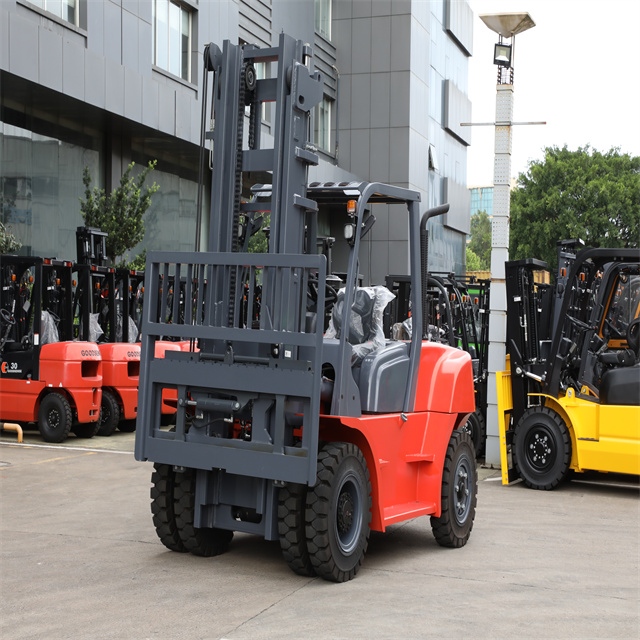
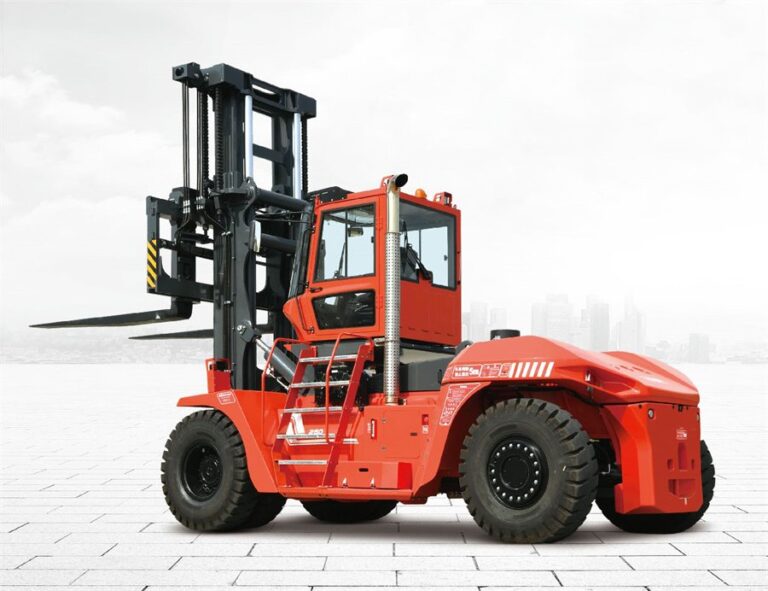
Alt:5-8T diesel forklift
A supplier can respond more accurately when the inquiry includes measured site data. A phone photo without dimensions is rarely enough. Send a simple plan view if possible and mark all fixed obstacles.
The request should include aisle width at the narrowest point, pallet dimensions, load weight, rack height, lowest overhead clearance, doorway dimensions, floor condition, shift hours, and any attachment. Short videos of the turning approach can reveal a column or staging pallet that a drawing misses.
Attachments need separate review. A side shifter, clamp, fork positioner, or longer fork can change front overhang, capacity, and the space needed to align a load. The approved truck-and-attachment data plate should match the delivered setup.
О вилочном погрузчике JinChengYu
JinChengYu FORKLIFT, based in Qingdao, supplies material-handling equipment and related support for overseas buyers. Its website covers counterbalance forklifts, warehouse equipment, rough-terrain machines, attachments, parts, and other logistics equipment. That range allows aisle discussions to begin with the job and building dimensions rather than forcing every warehouse into one truck type.
For a useful recommendation, buyers should share measured routes, loads, rack heights, floor conditions, and working frequency. The company’s contact team can then discuss configuration and availability against those site details. Final capacity and clearance should always be confirmed on the specification and data plate supplied for the chosen machine.
Заключение
Forklift aisle width is a working-space calculation, not a comparison of truck body widths. Measure the narrowest route, use the largest regular pallet, check right-angle stacking data, and allow room for real operating variation. A loaded site trial remains the best check when the available margin is small.
The right truck should complete the movement cleanly without repeated corrections or contact risk. Good measurements sent before quotation save more time than trying to solve a poor fit after delivery.
Часто задаваемые вопросы
These common questions cover the figures buyers usually need before comparing warehouse trucks.
What is forklift aisle width?
Forklift aisle width is the clear space needed for a truck and its stated load to turn, pick, place, and leave safely. The right-angle stacking aisle is usually more useful than overall truck width.
How much extra clearance should a forklift aisle have?
The allowance depends on the truck, pallet consistency, obstacles, floor, traffic, and local rules. Use the published stacking aisle as a starting point, then add a site-specific margin and verify tight layouts with a loaded trial.
Is turning radius the same as stacking aisle width?
No. Turning radius describes part of the truck’s circular path. Stacking aisle width also accounts for the load, fork position, front geometry, and room needed to approach a rack at 90 degrees.
Can a reach truck work in a narrower aisle than a counterbalance forklift?
Often yes, because a reach truck has a compact chassis and extends the load toward the rack. Floor quality, rack height, route transitions, load weight, and operating environment must still suit the machine.
What measurements should be sent to a forklift supplier?
Send the narrowest aisle, pallet size, maximum load, lift height, doorway and overhead clearances, floor condition, route layout, work frequency, and planned attachments.