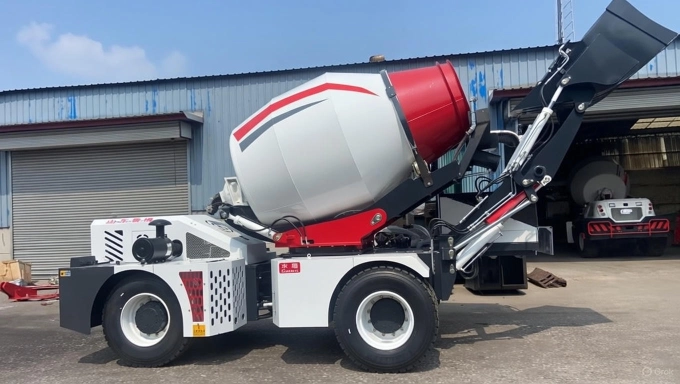
Selecting either a self-loading concrete mixer or a conventional concrete mixing truck does not only involve cost considerations alone. In fact, the less costly choice would depend on the location of the concrete production site, distance of travel, number of hands handling the concrete, and allowable delay of the project.
How Do the Two Concrete Systems Work?
Both machines deliver fresh concrete, but they belong to different production systems. That difference drives the real cost per cubic meter.
Self-Loading Concrete Mixer
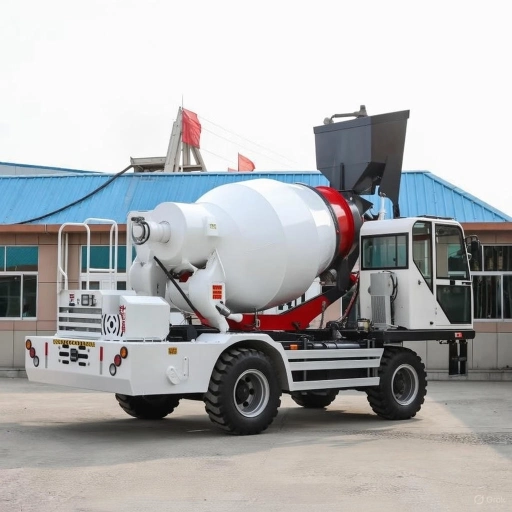
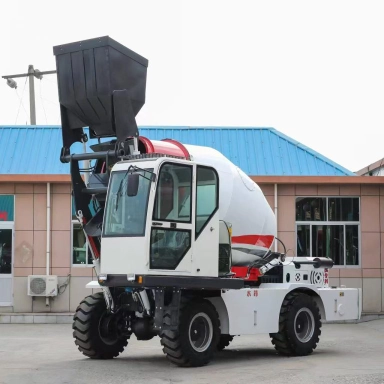
A self-loading concrete mixer performs functions such as loading aggregate, mixing the material, moving it short distances, and then discharging it within one mobile concrete mixer. An operator loads the sand and the stones using the loading bucket, and then mixes the ingredients with cement and water.
The machines employ four-wheel drive, hydraulics, water metering, and weighing on board. It produces concrete as per the requirement rather than ordering the same based on delivery schedule. It is suitable for the construction works in rural roads, drainage systems, farm structures, utility repairs, mountain construction, etc.
Camión hormigonera tradicional
A traditional concrete mixer truck, or transit mixer, normally receives concrete from a batching plant. Its job is to keep the load agitated during transport and deliver it to the site. It does not usually load raw materials or produce a complete batch by itself.
This system performs well when a dependable plant is nearby, access roads are good, and the job needs large, continuous pours.
Where Does the Money Go?
A fair comparison covers the full concrete supply chain. A lower equipment price can become expensive when it creates more labor, transport, waiting, or waste.
| Cost factor | Self-loading concrete mixer | Traditional mixer truck |
| Mano de obra | One operator handles several stages | Plant, driver, dispatch, and site crews are involved |
| Concrete source | Produced on site | Supplied by a batching plant |
| Transporte | Mostly within the site | Repeated road delivery |
| Small batches | Flexible | Often affected by minimum orders |
| Large pours | Limited by machine or fleet output | Strong with stable plant supply |
| Main risk | Integrated-system maintenance | Delivery delay and supply dependence |
Labor Cost
Labor is often the clearest saving. One trained operator can load, mix, move, and discharge concrete with an automatic loading concrete mixer. A traditional supply chain divides those tasks among plant staff, drivers, and site workers.
Fewer handoffs also reduce hidden labor. Crews spend less time calling suppliers, guiding trucks through narrow access, or standing idle while a delivery is late.
Fuel and Delivery Cost
A concrete mixer truck must travel from the batching plant to the jobsite and return. The bill includes loaded travel, empty travel, driver time, traffic, and possible distance surcharges.
A self-propelled concrete mixer burns fuel while loading, mixing, and moving around the site, but removes repeated ready-mix delivery trips. The saving is strongest when the nearest plant is far away or work is spread across several pour points.
Waiting and Concrete Waste
Concrete work rarely follows a perfect timetable. Excavation can run late, reinforcement may need correction, a pump can stop, or rain may interrupt a pour. If a full truck arrives at the wrong time, the contractor may pay waiting charges or reject material.
On-site concrete production lets the crew make smaller batches as work advances.
Ownership and Maintenance
A self-loading mixer has a loading arm, hydraulic circuit, water system, weighing parts, drivetrain, and mixing drum. All require service.
Compare total cost of ownership: fuel, filters, hydraulic oil, tires, drum cleaning, wear parts, training, financing, downtime, and resale value. For ready-mix supply, include minimum orders, waiting fees, rejected loads, and delivery surcharges.
Which Mixer Saves More in Real Projects?
There is no universal winner. Site layout, daily demand, delivery distance, and project duration decide which system produces cheaper usable concrete.
Remote or Dispersed Work
A self loading concrete mixer usually saves more on remote and scattered jobs. Examples include rural roads with culverts, irrigation channels, mine service roads, solar equipment bases, and small bridges without steady ready-mix supply.
It is particularly suitable when the project has:
- Several small pours each day
- Long travel from the nearest batching plant
- Limited labor or support equipment
- Muddy, uneven, or narrow access
- Frequent moves between work zones
- Batch quantities that change at short notice
High-Volume Urban Work
A traditional concrete mixer truck is often cheaper for large, uninterrupted pours near a commercial batching plant. A foundation requiring hundreds of cubic meters in one shift needs high, steady output. One mobile concrete mixer cannot match a well-run plant supported by a truck fleet.
Traditional delivery also makes sense when the site cannot store raw materials, local rules restrict material handling, or the specification requires plant-controlled structural concrete.
Short or Irregular Projects
Buying equipment for a brief contract may not make financial sense. Rental, subcontracted ready-mix, or a hired self-loading mixer can lower capital risk.
How Should Buyers Compare Quotes?
A useful quotation should match the project rather than list only engine power and drum size. Start with required daily output and the cost of the current supply method.
Calculate Cost per Cubic Meter
Add raw materials, labor, fuel, delivery, waiting, waste, cleaning, maintenance, and financing. Divide that figure by the usable concrete placed. Run the calculation for a normal month and a difficult month with delays or lower output.
A self batching concrete mixer may look expensive until delivery distance and idle labor are counted. The reverse can happen on a large city job with fast, dependable ready-mix supply.
Check Cost-Saving Features
Useful features reduce rework and downtime: accurate weighing, controlled water dosing, strong 4×4 traction, stable steering, practical discharge reach, simple drum cleaning, and accessible service points.
JinChengYu offers self-loading concrete mixers for compact through higher-output work, with batch capacities from about 1.6 to 4.0 cubic meters. Available equipment includes four-wheel-drive mobility, hydraulic operation, water control, and configurations for different terrain and discharge needs.
Review Supplier Support
Ask about operator training, preventive maintenance, common wear parts, shipping documents, warranty terms, and service response. Share the site gradient, road width, aggregate size, daily demand, climate, and pouring method.
JinChengYu Forklift: Side Loader Forklift Supplier
Carretilla elevadora JinChengYu is a company located in Qingdao, China that produces material handling, warehousing, ground support, and construction equipment for export to foreign markets. The side loaders produced by this company are used to carry long material such as steel pipes, timber, panels, and metals. Carrying the material on one side will help in saving aisle space and enhance handling in yard or production facilities.
Conclusión
For remote, mobile, small-to-medium, or irregular concrete work, a self-loading concrete mixer often saves more money in 2026 because it combines loading, batching, mixing, transport, and discharge while reducing delivery dependence. For high-volume projects near a reliable batching plant, traditional concrete mixer trucks usually provide faster continuous supply with less on-site production work.
The sound choice comes from calculating usable concrete cost under real site conditions. Daily output, travel distance, terrain, access width, and project duration should guide the machine configuration and quotation.
Preguntas frecuentes
Is a Self-Loading Concrete Mixer Cheaper Than Ready-Mix?
It can be cheaper when delivery distance is long, batches are small, labor is limited, or pours are scattered. Ready-mix may remain cheaper for large urban pours close to an efficient batching plant.
How Many Workers Are Needed?
A self-loading mixer is commonly run by one trained operator, although material handling, testing, placement, and site safety may require more workers. A traditional mixer truck needs a driver and separate plant and site teams.
What Size Self-Loading Mixer Is Best?
Choose capacity from hourly output, access width, ground condition, batch frequency, and discharge distance. An oversized machine raises fuel and capital cost. An undersized one creates extra cycles and schedule pressure.
What Should a Price Comparison Include?
Include purchase cost, shipping, duties, fuel, labor, maintenance, tires, wear parts, training, downtime, financing, and resale value. For delivered concrete, add minimum-order rules, waiting charges, rejected loads, and transport surcharges.