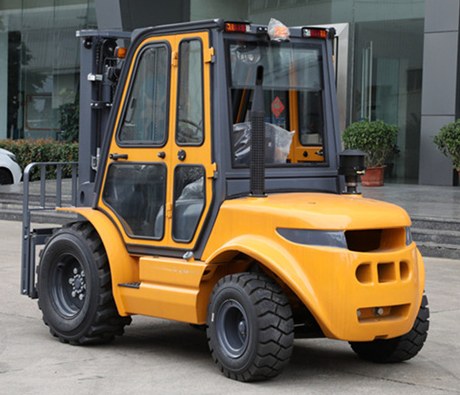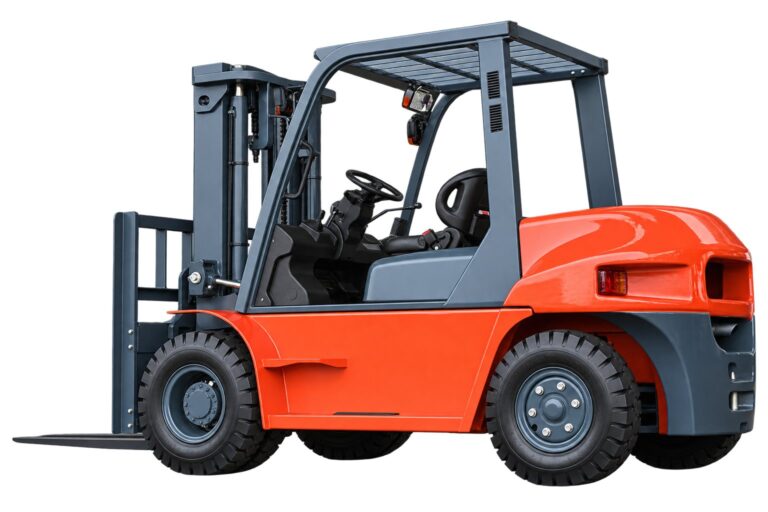
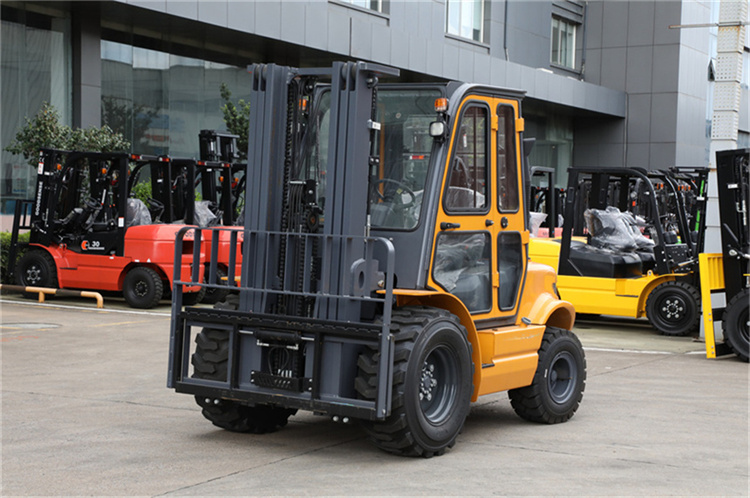
Ground clearance is the space between the lowest part of a rough terrain forklift and the surface below it. On a construction entrance, farm track, or gravel yard, that space can decide whether the truck keeps moving or rests on its chassis. A useful buying check combines the lowest clearance point, the site’s worst obstacle, the tire setup, and the height of the load while travelling.
What Ground Clearance Protects
The lowest point is often close to the axle housing, frame, belly plate, or a hydraulic component. When a wheel drops into a rut, the chassis does not follow the exact path of the tires. It can bridge the rut and touch the high centre. A clearance figure that looks adequate on level ground may disappear at a sharp approach or departure angle.
On an active site, contact has practical consequences:
- A scrape can bend a guard or damage a hose before the operator notices a leak.
- High-centering removes drive-wheel pressure and leaves a loaded truck stuck.
- Repeated impacts loosen fasteners and transfer shock into the mast and load.
- A low attachment or hanging pallet may touch first, even when the frame clears.
The rough terrain forklift range is intended for outdoor handling, but the route still needs a measurement. “Off-road” describes the design purpose; it is not a permission to ignore a site survey.
How Much Clearance Does a Site Need?
There is no single clearance number that fits every job. A yard with compacted gravel and shallow ruts may work with less space than a forestry track with rocks and deep wheel holes. A practical first screen is to compare the truck’s lowest stated point with the largest fixed obstacle, then leave room for suspension movement, tire deflection, and an angled crossing.
For example, if a track contains a 180 mm ridge, a 220 mm underbody measurement leaves only 40 mm on paper. Braking, a loaded front axle, and a diagonal approach can consume that margin. Buyers should ask for the clearance at the lowest point, the approach and departure angles, and any conditions attached to the published figure.
| Site feature | Why it changes the clearance decision | Field check |
| Ruts and washouts | One wheel may drop while the frame bridges the gap | Measure depth and width at the worst crossing |
| Rock or concrete lip | A sharp edge can hit a guard or axle | Check the lip height and approach angle |
| Loose gravel | Tires sink and reduce effective clearance | Inspect after rain and after heavy traffic |
| Load overhang | The pallet or attachment may strike before the chassis | Travel the route with the longest normal load |
This is why a specification sheet should start the conversation, not finish it.
Measure the Lowest Point, Not the Tyre Diameter
Tyre diameter is easy to see, but it does not tell the whole story. Walk around the truck with a tape measure and identify the lowest rigid part. Measure with the normal tires inflated to the working pressure and with guards, forks, and approved attachments installed.
Then record three heights:
- Lowest chassis or axle point.
- Lowest point of the attachment in the travel position.
- Lowest edge of a representative load, including pallet damage or uneven packing.
Repeat the check with the truck loaded if the manufacturer provides that procedure. A heavy load can change tire deflection and axle position. The difference may be small on hard ground and obvious on soft soil.
Breakover Angle and Transitions Matter More Than a Flat Measurement
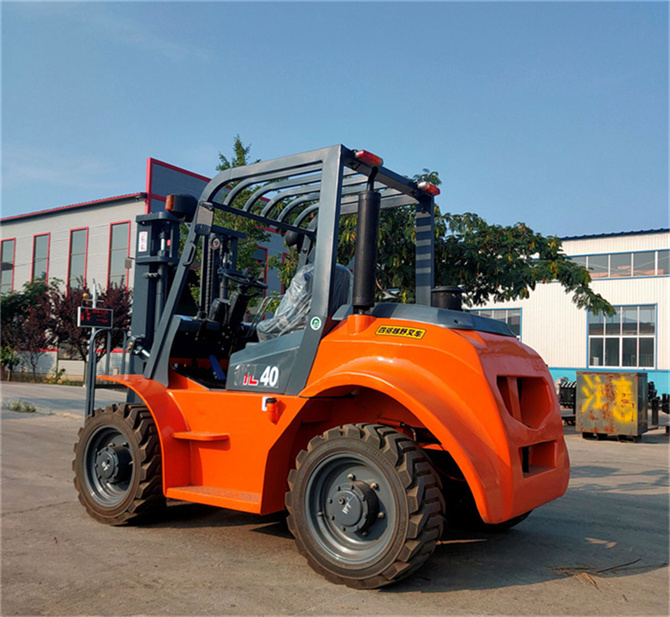
Many grounding incidents happen at the bottom of a ramp, beside a drainage channel, or on the crest of a temporary road. These are breakover points. The front tires have started climbing while the rear wheels remain on level ground, so the centre of the truck moves close to the surface.
Leave a transition zone around the obstacle. A 150 mm ditch with a vertical edge is harder to cross than a 200 mm shallow dip with compacted sides. If the route includes a turn, check the inside wheels as well. Steering changes the path of the rear axle and can place it against a mound that the front axle cleared.
When a diesel forklift is being considered for a mixed yard, request the dimensional drawing and ask which points define ground clearance. A drawing is also useful for checking a fork carriage, bucket-style attachment, or towing hitch that sits lower than the standard configuration.
Clearance Works With Traction, Tyres, and Drive Layout
Extra space under the frame does not create grip. A high-clearance truck can still spin on wet clay or slide sideways on a cambered track. Four-wheel drive can improve traction when the surface is loose, but it does not remove the need to control speed and load height.
Tyres influence the result in two ways. Pneumatic tyres absorb stones and maintain contact over small steps; solid tyres resist punctures but may transmit more shock to the machine. The right choice depends on debris, travel distance, axle loads, and whether the truck moves between a yard and a paved loading dock.
Keep the load low while travelling. A 2.5 m steel bundle raised to clear a barrier can shift the centre of gravity and make a short, angled crossing less stable. Ground clearance should be checked together with overhead clearance, turning space, and visibility.
A Simple Site Survey for Buyers
Before requesting a quotation, collect a short route record. It gives the supplier enough context to discuss a suitable configuration and prevents a false comparison between catalogue numbers.
- Mark the full travel path, including entry, stockpile, loading point, and exit.
- Photograph the deepest rut, highest ridge, sharpest transition, and softest section.
- Record the largest load, load length, pallet condition, and required travel speed.
- Note wet-weather changes and whether the route is repaired during the shift.
- Ask for loaded dimensions, axle loads, approach angles, and the lowest attachment point.
The case studies on outdoor handling can help frame the questions, while a supplier should confirm the actual configuration in writing.
Common Clearance Mistakes
Before looking at specific clearance mistakes, it is important to understand that many problems come from how clearance information is interpreted rather than from the machine itself.
Comparing a marketing figure with a working dimension
A maximum clearance may refer to one point, an unloaded truck, or a special tyre. Ask for the measurement that matches the delivered machine and the daily attachment.
Measuring only in the dry season
Rain changes rut depth, soil strength, and tyre sink. A route that is comfortable in August may need a different crossing plan in a wet month.
Raising the forks to clear an obstacle
Forks raised high change stability and visibility. Remove or repair the obstacle when possible; keep the forks low when travelling.
Ignoring service access
Guards and underbody panels protect components, but they also affect the lowest point. The JinChengYu service team can review drawings, spare parts, and the maintenance access needed for the intended route.
JinChengYu FORKLIFT in Brief
Qingdao JinChengYu Machinery Co., Ltd. presents itself as a one-stop logistics handling solution provider serving overseas buyers with forklifts, attachments, warehouse equipment, and related support. Its website lists rough terrain and side loader categories alongside sales, after-sales, rental, and contact services. For a procurement team, the useful point is the breadth of the conversation: route conditions, attachment choice, parts, and service can be discussed together, while final specifications should be confirmed for the selected configuration.
Conclusion
Ground clearance matters because uneven sites rarely present one clean obstacle. Ruts, ridges, transitions, tyre sink, and load position combine to set the real limit. Measure the lowest point, inspect the whole route, and compare the loaded machine with the actual attachment. That process produces a more reliable rough terrain forklift choice than a single headline number.
FAQs
What is ground clearance on a rough terrain forklift?
It is the vertical distance from the ground to the forklift’s lowest rigid component. The useful value is tied to a specific tyre, load, attachment, and measurement point.
Is higher ground clearance always safer?
Higher clearance reduces the chance of chassis contact, but it does not replace traction, braking, stability, or route maintenance. The complete site condition still controls safe travel.
How should ground clearance be measured?
Identify the lowest chassis, axle, guard, and attachment points. Measure with working tyre pressure and repeat the check with the normal load where the supplier’s procedure allows it.
Can a rough terrain forklift work on a muddy site?
It may, when the tyres, drive layout, load, and route are suitable. Mud can reduce grip and increase tyre sink, so the wet-weather route should be assessed separately.
What information should a buyer send to a supplier?
Send the worst obstacle height, rut depth, ramp transitions, surface condition, load dimensions, attachment, travel frequency, and photographs or measurements of the route.