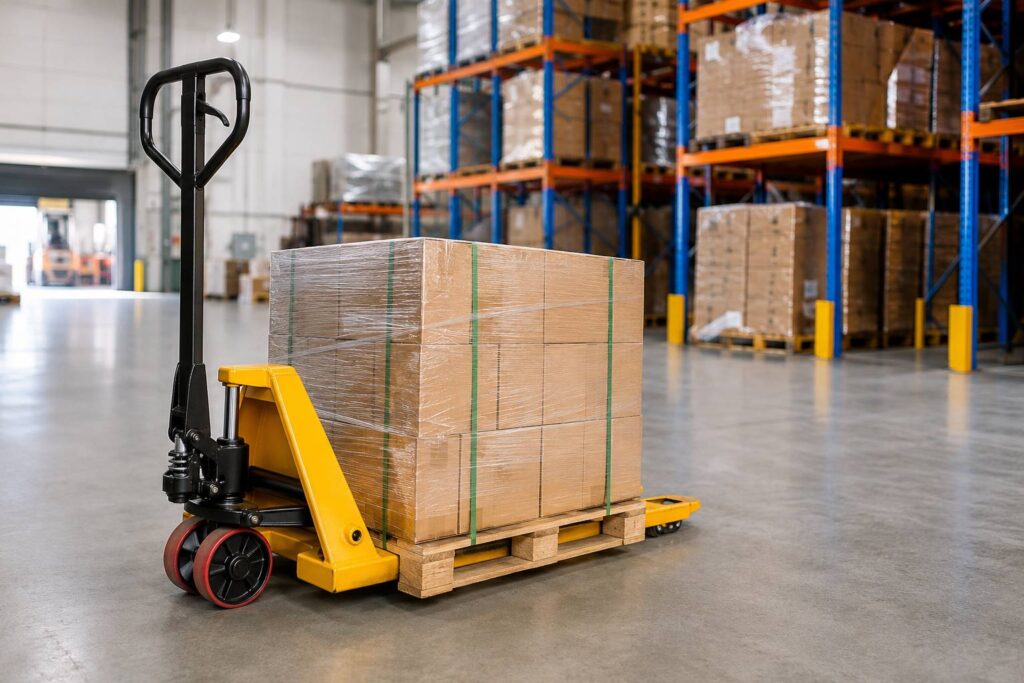
A hand pallet truck looks simple, but a small sizing error can cause daily delays. Forks that are too wide may not enter the pallet. Forks that are too long can project beyond the load and strike nearby goods. A truck that is too large for the aisle may also be hard to turn.
The right choice starts with the pallet, not load capacity alone. Dimensions, entry direction, floor condition, load shape, and working space all affect which manual pallet jack will perform well.
Why Pallet Truck Dimensions Matter
Fork dimensions affect load support, turning space, wheel position, and operator visibility. A correctly sized truck should enter cleanly, support the load without excessive overhang, and withdraw without catching the bottom boards.
Poor matching can damage pallet blocks, cartons, rollers, and nearby stock.
Start With the Pallet You Actually Use
Repaired, imported, and locally made pallets may differ from the stated standard. Measure several samples before ordering.
Measure Width, Length, and Entry Direction
Record the outside width and length in millimetres. Then identify the sides from which the pallet truck can enter. A four-way pallet may accept forklift forks from four sides but still limit pallet jack access because the load rollers must travel beneath the deck.
Entry direction changes the required fork length. An 800 × 1,200 mm Euro-style pallet is commonly entered from the 800 mm side. A 1,000 × 1,200 mm industrial pallet may be handled from either side, depending on its bottom boards and storage layout.
Check these points:
- Clear distance between pallet openings
- Internal height for lowered forks and rollers
- Position of blocks, boards, nails, and damaged timber
- Amount of fork tip extending beyond the load
Forks should support the pallet without projecting far beyond the opposite edge. Exposed tips can puncture packaging, while short forks may leave the far side poorly supported.
Common Fork Sizes and Applications
There is no universal pallet jack size. Regional pallet standards have produced several common combinations.
| Approximate fork size | Typical application | Main checks |
| 520–550 mm × 1,150 mm | Euro-style pallets and narrow skids | Opening width and side entry |
| 680–685 mm × 1,220 mm | 40 × 48 inch pallets and wide industrial pallets | Turning room and fork overhang |
| Below 1,000 mm long | Half pallets, display pallets, vans | Load support and pallet structure |
| Above 1,220 mm long | Oversized pallets and long loads | Balance, capacity, and aisle space |
These figures are starting points. Pallets with the same outside dimensions can have different underside structures.
Narrow Forks for Euro-Style Pallets
A narrow hand pallet truck is often selected for 800 × 1,200 mm pallets. An overall fork width around 520–550 mm usually provides clearance between the blocks while keeping the load centred.
Confirm that the listed width means the total distance across the outside edges of both forks. Some specification sheets list the width of one fork instead.
Wide Forks for 40 × 48 Inch Pallets
A manual pallet jack near 685 mm wide and 1,220 mm long is commonly paired with 40 × 48 inch pallets. Measure door openings, rack clearances, tail-lift platforms, and the distance between staged pallets.
A truck that fits the pallet but cannot turn at the aisle end is still the wrong size.
Short and Long Forks for Special Loads
Short forks suit half pallets, display pallets, delivery vans, and compact production cells. Long forks serve oversized packaging and long skids.
Longer forks do not automatically carry more weight. Rated capacity, frame strength, hydraulic design, and load-centre position still set the safe limit.
Match the Truck to the Working Area
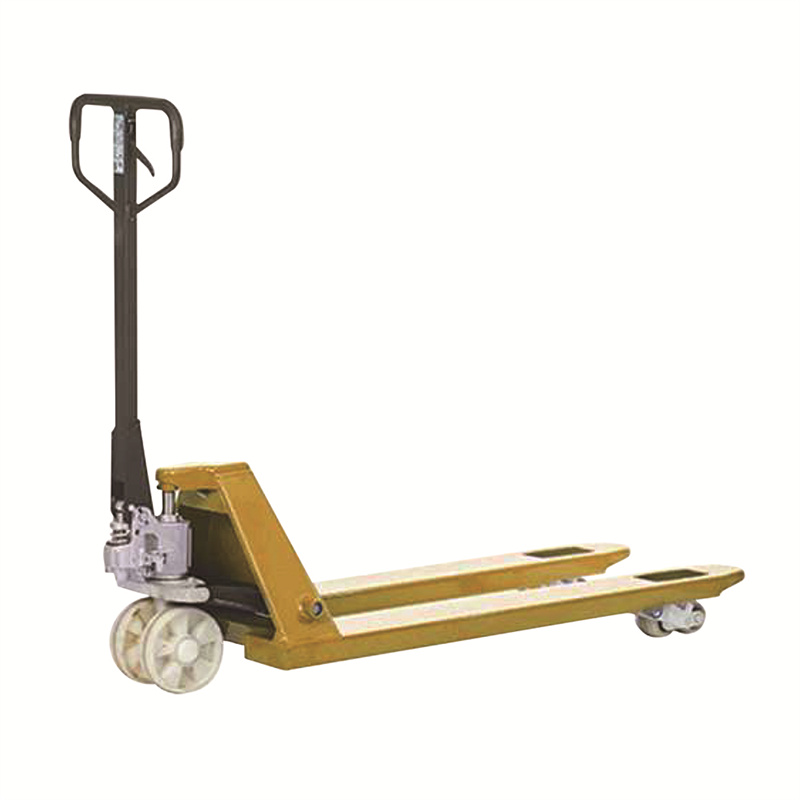
After confirming pallet compatibility, review the route from pickup to set-down. The chosen dimensions must work through every doorway, turn, and staging point.
Measure Aisles and Turning Space
Measure the narrowest point, including door frames, barriers, columns, ramps, rack ends, and goods projecting into the aisle. Allow room for the fork length and steering handle as it swings.
Mark the proposed fork length, width, and handle sweep on the floor. This can reveal conflicts missed on a product drawing.
Check Lowered Height and Lift Range
The forks and entry rollers must pass under the pallet without forcing the boards upward. Low-clearance pallets may require a low-profile truck.
Lift only until the rollers clear the floor and the load remains level.
Select Capacity for the Real Load
Use the highest actual pallet weight, including the pallet and packaging, rather than an average. Never exceed the capacity plate.
Load shape matters. Keep the load centred and restrain unstable goods.
Choose Wheels and Rollers for the Floor
Wheel material affects noise, rolling resistance, grip, and wear. Single or tandem load rollers also change how the truck crosses joints and pallet boards.
| Working condition | Practical consideration |
| Smooth concrete | Low rolling resistance and easy steering |
| Retail or quiet area | Low-noise wheels and smooth bearings |
| Floor joints and thresholds | Tandem rollers for smoother crossing |
| Food or chemical area | Cleaning needs and material resistance |
| Rough or damaged floor | Repair the route or use suitable equipment |
Standard hand pallet trucks are not suitable for potholes, steep slopes, broken dock plates, or severely damaged floors.
Hand Pallet Truck Buying Checklist
Before requesting a quotation, collect:
- Pallet size, underside clearance, and entry sides
- Maximum loaded weight
- Required fork width and length
- Narrowest aisle and doorway
- Floor type, joints, and ramps
- Daily pallet moves and travel distance
- Noise, marking, or chemical-resistance needs
- Preferred single or tandem rollers
- Order quantity, destination, and branding needs
Accurate information helps a supplier recommend a suitable configuration rather than a generic unit.
JinChengYu FORKLIFT as a Handle Pallet Truck Supplier
JinChengYu FORKLIFT supplies hand pallet trucks and other warehouse handling equipment for overseas applications. Its manual units use a three-position handle for lifting, travel, and controlled lowering. Available features include a fully cast hydraulic pump, overload protection, sealed cylinders, reinforced steel plates, and wear-resistant load wheels.
Wheel materials can be selected for different floor, noise, wear, and chemical-resistance needs. Single or double load-wheel arrangements are available. Equipment receives final inspection and servicing before shipment. Mixed orders and logo customization can be arranged for distributors and fleet buyers.
Buyers can review application cases or send pallet measurements, load details, and working conditions through the contact page.
Conclusion
Choosing the right hand pallet truck size is a measurement task, not a guess based on a catalogue image. Start with pallet width, length, underside clearance, and entry direction. Then match fork dimensions to aisle space, load weight, floor condition, wheels, and daily travel.
Before ordering, send the supplier a pallet drawing or clear underside photos with the maximum load and route dimensions. This can prevent damaged pallets, costly returns, and equipment that does not fit the job.
Frequently Asked Questions
What is the standard hand pallet truck fork width?
Common overall fork widths are about 520–550 mm for Euro-style and narrow pallets and about 680–685 mm for wider industrial pallets. The correct width depends on the clear openings under the actual pallet.
What fork length suits a Euro pallet?
A fork length close to 1,150 mm is widely used when an 800 × 1,200 mm pallet is entered from its short side. Check the underside structure and fork projection before confirming the size.
Will a 685 mm pallet jack fit a Euro pallet?
Usually not through the standard narrow opening. The forks may contact blocks or bottom boards. Measure the clear opening rather than relying only on outside dimensions.
Should fork size or load capacity be checked first?
Both are essential, but pallet compatibility should be confirmed before paying for extra capacity. A high-capacity truck has little value if its forks cannot enter the pallet or turn in the available aisle.