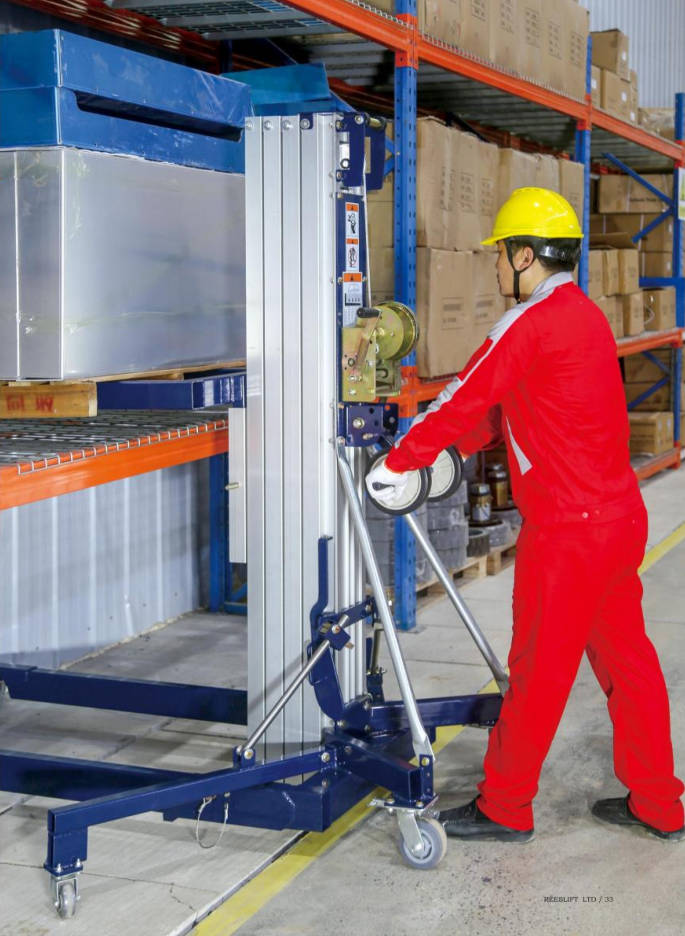
A portable aluminum material lift with a manual winch is built for one job: raising heavy, awkward items to working height without electricity, hydraulics, or a forklift. On real sites, that usually means getting duct sections tight to a ceiling line, holding an air-conditioning unit in place while it’s bolted, or lifting steel members and cable trays to a safe install height. The winch gives controlled lifting and controlled lowering, and the aluminum mast keeps the whole machine light enough to move through doorways and load into a pickup.
Before getting into features and use cases, it helps to define what “function” means in practice: what problems the tool solves, how it behaves under load, and where it fits between ladders, chain hoists, forklifts, and powered lifts.
The real function on-site: controlled lifting, positioning, and holding
Most jobsite injuries around overhead installs come from two moments: the uncontrolled lift and the uncontrolled slip. A manual-winch material lift reduces both risks by turning a hard “dead-lift” into a slow, predictable movement. That matters when the load is bulky (ductwork), fragile (lighting fixtures), or dangerous to balance (an AC air handler).
The lift’s function is not only “go up.” It also works as a temporary third hand. The forks or platform can hold a load steady at the exact height needed while a crew aligns fasteners, checks level, and makes final connections. Because the winch can move in small increments, installers can creep the load into place instead of trying to muscle it the last few centimeters.
On many portable models, the machine is designed for one-person movement and setup, while the load handling still follows normal site rules: confirm weight, confirm load center, confirm overhead clearance, then lift. This “one-person operation” concept is common for material lifts aimed at indoor construction and MEP work.
How the manual winch creates safe, repeatable lifting
A manual winch material lift is simple, but not primitive. The winch drum winds a cable (or strap/chain on some designs) that drives the carriage upward along a telescoping mast. The key functional advantage is mechanical advantage: the handle turns many times, and the load rises a small distance each turn. That makes lifting feel smooth instead of explosive.
Between H2 and H3, one point needs emphasis: the winch is only half the safety story. The other half is what happens when the handle is released.
Automatic braking: why “hands-off” control matters
A practical jobsite requirement is that the lift should not back-drive when the operator stops cranking. Many material-lift designs use an automatic braking mechanism inside the winch so the load stays where it is without relying on the operator’s grip strength.
This braking behavior is the reason a manual lift can function as a positioning tool, not just a hoist. It also makes lowering more controlled, because the operator is working against the brake and gear train rather than fighting gravity with a free-spinning handle.
Telescoping mast behavior under load
On telescoping masts, sections rise in sequence, but manuals often note that, near maximum capacity, mast sections may not rise perfectly “in order.” That does not necessarily mean the lift is failing; it reflects how load and friction distribute through nested sections. Operators are typically instructed to keep the unit vertical and follow the manufacturer’s procedures so the safety systems release and re-engage correctly.
Why aluminum is more than a weight-saving choice
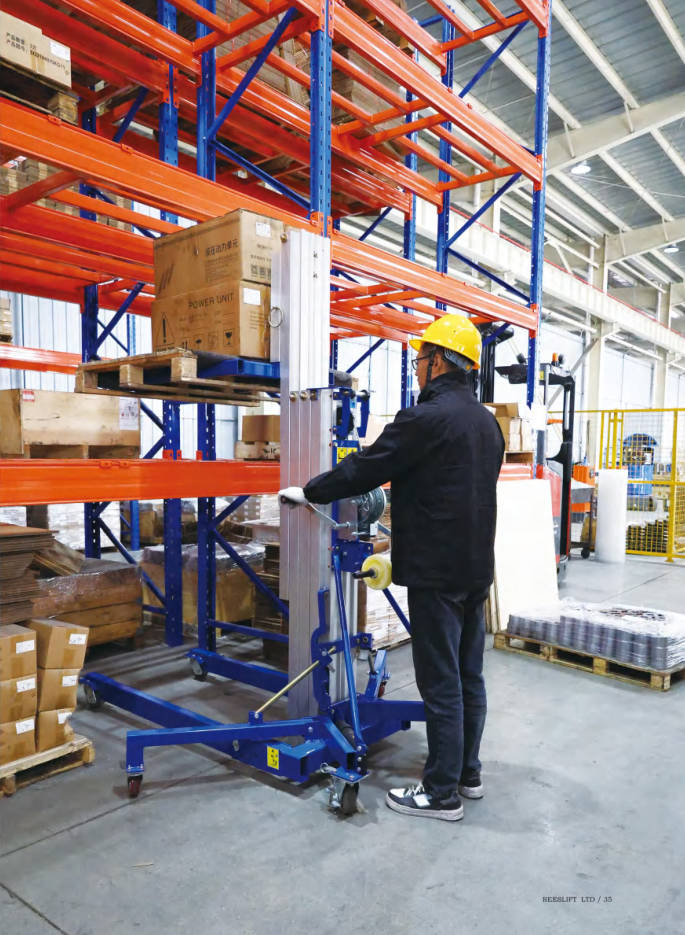
Aluminum construction changes the way the lift functions day-to-day. The obvious benefit is portability: lighter frames are easier to tilt back onto transport wheels and push through single doors.
The less obvious benefit is workflow. On renovation jobs, crews often move equipment across finished floors and through tight corridors. A lighter lift reduces fatigue and reduces the temptation to “just lift it by hand.” Aluminum masts are also commonly described as aircraft-grade or aviation-grade in product literature, reflecting a focus on strength-to-weight ratio for telescoping structures.
What it replaces (and what it doesn’t)
A portable manual lift is not trying to replace every lifting method. It replaces the risky middle ground: lifting heavy items overhead with ladders, makeshift rigs, or multiple workers straining in awkward positions.
It does not replace a forklift for long-distance pallet transport or very heavy loads. It also does not replace a scissor lift for moving workers. Instead, it fits a specific niche: short-range vertical lifting and precise placement of materials.
If the job is indoor HVAC, electrical, stage rigging, or light warehouse handling, this niche is often exactly what slows teams down. The lift’s function is to remove the bottleneck at the install point.
Where manual-winch material lifts get used most
The strongest-performing articles in this topic tend to do three things well: they name real tasks (not vague industries), they explain the mechanism and safety logic, and they help buyers match a lift to the job by height, capacity, and handling method. Following that pattern, here are the most common application environments described for portable manual material lifts.
A natural bridge into specific scenarios is that the same machine can be “right” or “wrong” depending on attachments, clearance, and how the load is shaped.
HVAC ductwork and indoor air equipment
For duct installation, the lift’s forks or cradle support long rectangular duct sections while installers align hangers and seal joints. Many product descriptions call out duct lifting and AC-unit positioning as primary use cases, because the loads are bulky, overhead, and difficult to hold steady by hand.
A practical detail: ductwork often needs small height adjustments to match a slope or clear obstructions. That’s where the winch’s fine control matters more than raw lifting speed.
Electrical and overhead mechanical installs
Cable trays, lighting assemblies, and some transformers are heavy enough to injure a crew but light enough that teams try to “just get it done” without equipment. A manual material lift changes that decision. It provides a stable raising platform so the crew can focus on alignment and fasteners rather than load balance.
Warehouses, mezzanines, and back-of-house lifting
In warehouses, the use case is often moving parts, cartons, or fixtures up to mezzanine levels or service platforms when a forklift can’t access the area. Some portable lifts are described as handling loads up to about 450 kg (roughly 1,000 lb) at a defined load center, which is enough for many maintenance and facility tasks.
Selecting the right lift: function comes from matching specs to the task
A lift’s “function” is only reliable when the setup matches the job. Three variables dominate: working height, load capacity at a given load center, and base stability.
Working height should be chosen based on the install point, not the ceiling height. If a duct run is installed at 4.2 m, the lift needs extra headroom for positioning and small corrections.
Capacity must be interpreted correctly. Many material lifts specify capacity at a load center (for example, a distance like 36 cm from the fork face). Loads that extend farther out effectively become heavier because they increase tipping moment.
Stability comes from the base design and setup. Operator manuals repeatedly stress level ground and hazard checks (overhead obstructions, slippery surfaces, drop-offs). Those are not formalities; they directly affect whether the safety systems behave as intended.
Operating safety that directly supports the lift’s function
A portable aluminum material lift is safe when it’s used like a lifting device, not like a cart, ladder, or crane substitute.
The most important rule is environment control: keep the lift on a firm, level surface and inspect the work area for hazards before raising the mast. The next rule is electrical clearance. Material lifts are typically not insulated, and manuals warn against operating near power lines because the machine does not protect against electrical current.
Finally, treat the winch as a load-control device. If the machine is not vertical, some safety brakes may not release correctly, and the mast may not behave predictably.
Supplier snapshot: JinChengYu FORKLIFT in the portable lift supply chain
According to this website and the uploaded company materials, JinChengYu FORKLIFT operates from Qingdao with transportation access by land, sea, air, and rail, supporting import and export business across materials handling, GSE, and warehouse equipment categories.
The same sources describe an established sales and service network that covers sales, after-sales, and rental support for global customers.
For portable aluminum material lifts with manual winches specifically, the product information emphasizes non-powered lifting, a manual winch with automatic braking, and a lightweight build intended for single-person movement through standard doorways, as well as international delivery starting from Qingdao Port.
Conclusion
The function of a portable aluminum material lift with a manual winch is simple to describe but powerful in daily work: it replaces risky overhead lifting with controlled, mechanical lifting and stable positioning. The winch provides the fine movement needed for ductwork, lighting, cable trays, and similar installs, while the mast and braking system are what turn “lifting” into “holding.” When the lift is matched to the correct height and capacity, set up on level ground, and kept away from electrical hazards, it becomes one of the most practical tools for indoor construction, HVAC, and facility maintenance workflows.
FAQs
What is the main function of a portable aluminum material lift with a manual winch?
Its main function is to raise, position, and hold heavy materials at working height with fine control, without electrical power or hydraulics. The manual winch provides controlled lifting and lowering, and many designs include an automatic braking mechanism to keep the load steady when cranking stops.
Is a manual-winch material lift safe for overhead installation work?
It can be, when the lift is used on firm, level ground, the area is checked for hazards, and the unit is kept clear of power lines. Operator manuals commonly warn that these lifts are not insulated and should not be operated near electrical hazards.
Can one person operate and move a portable aluminum material lift?
Many portable designs are intended for single-person movement because the aluminum construction keeps the overall weight manageable and the unit can be tilted back on wheels to pass through doorways. Actual lifting should still follow site procedures, including checking load weight and controlling the work area.