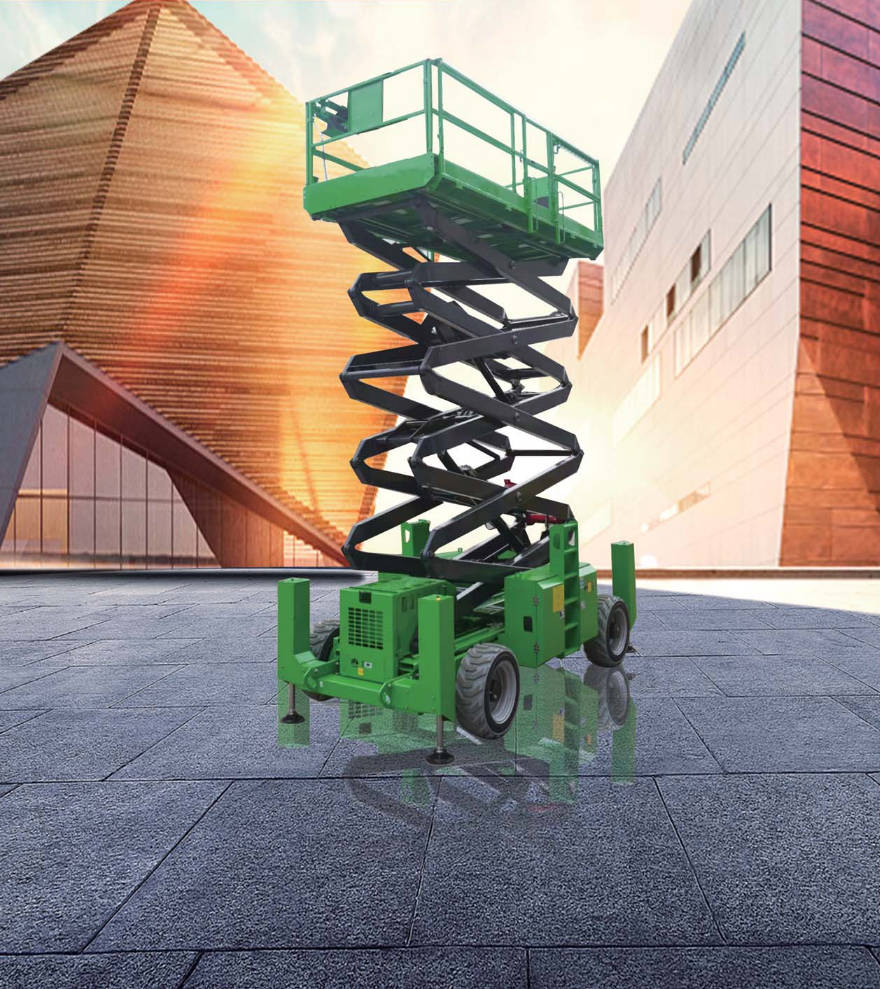
A rough terrain scissor lift is built for one job: put people, tools, and materials at working height when the ground below is uneven, loose, or changing throughout the day. Compared with a standard indoor scissor lift, an off-road scissor lift focuses less on smooth floors and more on traction, stability, and getting across a jobsite without constant repositioning.
This guide focuses on the real function of a rough terrain scissor lift in two common mobility styles: a wheeled scissor lift and a tracked scissor lift (often called a crawler scissor lift). It also covers practical selection rules, outdoor safety points, and the features that matter most when the surface is gravel, soil, mud, or a partially finished slab.
What a rough terrain scissor lift is built to do
Outdoor access equipment is judged by how it behaves when conditions are not perfect. The “function” is not only vertical lift. It is vertical lift that stays controllable when the ground is unpredictable.
Provide stable vertical access on uneven ground
The platform rises straight up, giving a wide, guarded workspace for jobs that need repeated up-and-down cycles. On rough sites, the key is keeping the chassis stable while the platform is elevated. Many rough terrain machines rely on heavy-duty structures and stabilization systems to keep the platform steady when the surface has small height differences or minor slopes.
Move around the work area with fewer resets
A rough terrain scissor lift is meant to relocate around an outdoor site where the “path” may be compacted soil, gravel, or debris. Four-wheel drive layouts, deep-tread tires, or rubber tracks exist to keep the machine moving without getting stuck at the first soft patch.
Maintain traction and control when the surface changes
Outdoor ground changes fast. Morning moisture can soften soil. Trucks can rut a path. A lift that worked fine at 8 a.m. can struggle at 3 p.m. That is why rough terrain designs emphasize traction and stability features rather than purely compact size.
Wheeled vs tracked rough terrain scissor lifts
Both styles lift vertically. The difference is how they manage ground contact, turning, and pressure on the surface. That choice affects productivity more than most buyers expect.
When a wheeled rough terrain scissor lift fits best
A wheeled scissor lift is usually the faster option across firmer ground. On packed dirt, gravel, or a jobsite with temporary road base, wheels typically travel quicker and steer more easily. Many rough terrain wheeled units are designed for outdoor work with features like foam-filled tires, 4WD, and grade handling that suit construction-oriented sites.
Wheels also make sense when the lift must be moved frequently between areas that are already reasonably firm, such as a large industrial yard, a logistics expansion project, or a site where the access roads are maintained.
When a tracked scissor lift is the safer call
A tracked scissor lift shines when the ground is soft or easily damaged. Rubber tracks spread weight over a larger contact area, lowering ground pressure and helping the lift “float” over conditions that can swallow wheels. This is why crawler scissor lift platforms are commonly chosen for muddy ground, sand, turf, and mixed terrain where ruts become a problem.
Tracks also tend to improve traction and stability when the surface is uneven or slippery. That matters for outdoor maintenance tasks on unfinished sites, and it matters even more when the machine must reach a specific point without tearing up the approach path.
How to decide on mixed-terrain jobsites
When the site is mostly firm and travel distance is long, wheels often win on speed. When the site includes soft zones that cannot be avoided—fresh backfill, wet soil, landscaping areas, or shoulder zones near roads—tracks often prevent wasted time recovering a stuck lift. A practical way to think about it is simple: if ground conditions require a skid steer to stay on tracks, a tracked scissor lift is usually the safer match.
Where these lifts are used in real work
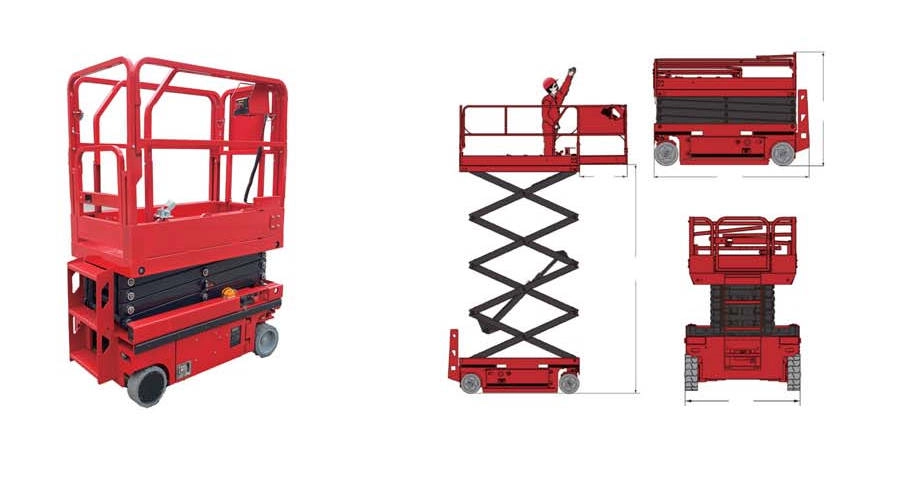
The value of an all terrain scissor lift shows up in repetitive, time-sensitive outdoor tasks where ladders and scaffolding are slow to move and hard to keep level.
Exterior construction and envelope work
Rough terrain scissor lifts are commonly used for building exteriors: façade prep, insulation, cladding, glazing support tasks, and punch-list work along long elevations. They also fit well in tilt-up construction and general contractor workflows where work shifts between inside and outside as the structure closes in.
Outdoor maintenance on industrial sites
Plants and yards often have uneven surfaces, patched pavement, cable ramps, and drainage slopes. A rough terrain lift supports tasks like lighting replacement, pipe-rack work at low-to-mid elevations, exterior ducting, and equipment installation where a stable deck for tools saves trips up and down.
Infrastructure, utilities, and energy sites
Bridge-side lighting, sound barriers, solar farms, and utility work frequently require access over unpaved service roads. In these settings, a tracked scissor lift can reduce getting bogged down in shoulder areas, while a wheeled rough terrain lift can cover long distances quickly when roads are compacted.
Temporary access for events and grounds work
Staging, outdoor venues, and facility grounds teams often face turf protection requirements. Tracks can reduce surface disturbance compared with aggressive tires, especially after rain.
Key functions that affect productivity and safety
Specs matter, but the “function” buyers care about is the workday outcome: fewer delays, fewer resets, and fewer unsafe workarounds.
Stabilizers and support systems for uneven surfaces
Many rough terrain designs use hydraulic outriggers or stabilizers to help secure the machine on surfaces with elevation differences. In practice, outriggers matter most when the lift is working near the edge of a slab, over compacted fill, or on sites where “level ground” is hard to find.
Platform space and capacity for tools and materials
Outdoor tasks often involve heavier tool loads: anchors, drills, glazing tools, sealants, or bundles of fasteners. Rough terrain scissor lifts are often positioned as higher-capacity platforms with broader decks than typical indoor units, which reduces the temptation to overload or make extra trips.
Working height range that matches common exterior tasks
Many outdoor scissor lifts are selected in mid-range working heights that cover common exterior needs—commercial façades, canopies, warehouse eaves, and light industrial structures—without stepping into larger boom-lift territory.
Power choice: diesel vs battery for outdoor operation
Diesel remains common outdoors because it supports long shifts and frequent travel without charging constraints. Battery-powered rough terrain scissor lifts are increasingly chosen for noise-sensitive sites or emission-restricted areas, especially when the lift must work near occupied buildings. Both options are used in the market, and many product lines offer either configuration depending on jobsite rules.
Safety and compliance basics for rough terrain scissor lifts
Outdoor capability does not remove basic rules. It raises the stakes because uneven ground is one of the main drivers of instability incidents.
Ground selection, slopes, and site control
Safe operation starts with the surface. Guidance for scissor lifts emphasizes choosing firm, level areas away from hazards that can cause instability, and using traffic control so other equipment cannot contact the lift.
Even on a machine designed for rough ground, operators still need to respect slope limits, avoid drop-offs and holes, and follow the manufacturer’s movement instructions—especially when elevated.
Standards buyers should recognize: ANSI A92 updates
Modern MEWP standards add expectations around stability testing, tilt sensing, and equipment configurations for rough terrain use. Buyers and fleet managers often reference ANSI A92 updates when setting internal safety rules and training requirements.
About JinChengYu FORKLIFT as a supplier
JinChengYu FORKLIFT operates from Qingdao, Shandong Province, with transportation access by land, sea, air, and rail, and focuses on import/export and overseas supply for materials handling, ground support equipment, and warehouse equipment.
The company states a service approach built around consistent product quality and customer satisfaction, supported by a sales and service network that includes after-sales support and rental-style service options for global customers.
For buyers sourcing rough terrain access equipment, that combination matters. Outdoor lifts are not only about the platform; they are also about parts planning, response time, and matching the correct wheeled or tracked configuration to the ground conditions the machine will actually see.
Conclusion
The function of a rough terrain scissor lift is straightforward in theory—lift crews to height—but demanding in practice. Wheeled scissor lifts usually serve fast-moving sites with firm ground. Tracked scissor lifts handle soft, sensitive, or muddy terrain where traction and ground pressure decide whether work continues or stops. Matching the lift to real ground conditions, and running it with basic outdoor scissor lift safety discipline, is what keeps projects on schedule.
FAQs
When should a wheeled rough terrain scissor lift be chosen instead?
Wheeled units are often preferred when the site has firm travel paths, longer travel distances, and a need to move quickly between work zones. Wheels can also simplify transport logistics in many fleets.
Do rough terrain scissor lifts need stabilizers?
Stabilizers can be valuable when the surface is uneven or when steadiness is critical for precise work. Whether they are needed depends on the jobsite conditions and the type of tasks performed at height.
What are we checks before lifting outdoors?
The surface condition and slope are the first checks, followed by site hazards like holes, drop-offs, overhead obstructions, and traffic exposure. Scissor lift safety guidance stresses firm, level surfaces and traffic control measures to prevent contact from other equipment.