When a facility team needs safe access above ground level, the first question is usually simple: should the job be done with an aluminum vertical mast lift or a scissor lift?
At first glance, both machines raise people and tools. In actual use, they solve very different problems. One is built for narrow access, lighter floor loading, and fast indoor maintenance. The other is built for wider platforms, more platform capacity, and frequent repositioning across larger work zones.
For people who buy equipment, contractors, warehouse workers, and building care teams, the wrong choice can slow down the work. It can create access problems too. And it can raise operating costs. The right choice can cut setup time. It can reduce labor pressure. And it can make daily work much smoother. This guide breaks down the differences in simple language. It uses practical examples from real indoor places. These include hotels, malls, airports, warehouses, and public buildings.
What Is the Main Difference Between a Vertical Mast Lift and a Scissor Lift?
Before comparing use cases, it helps to look at how each platform is built and why that matters on site.
Aluminum Vertical Mast Lift: Built for Tight Access
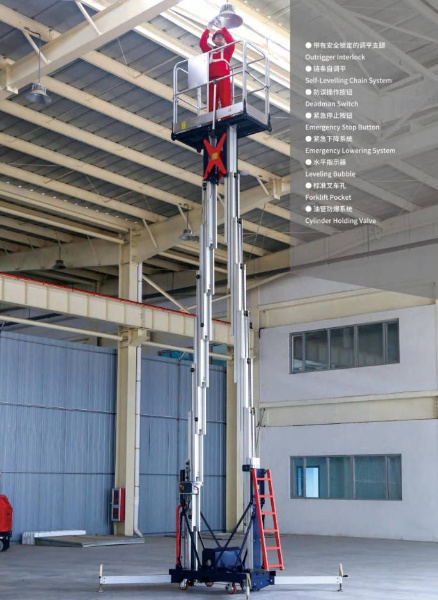
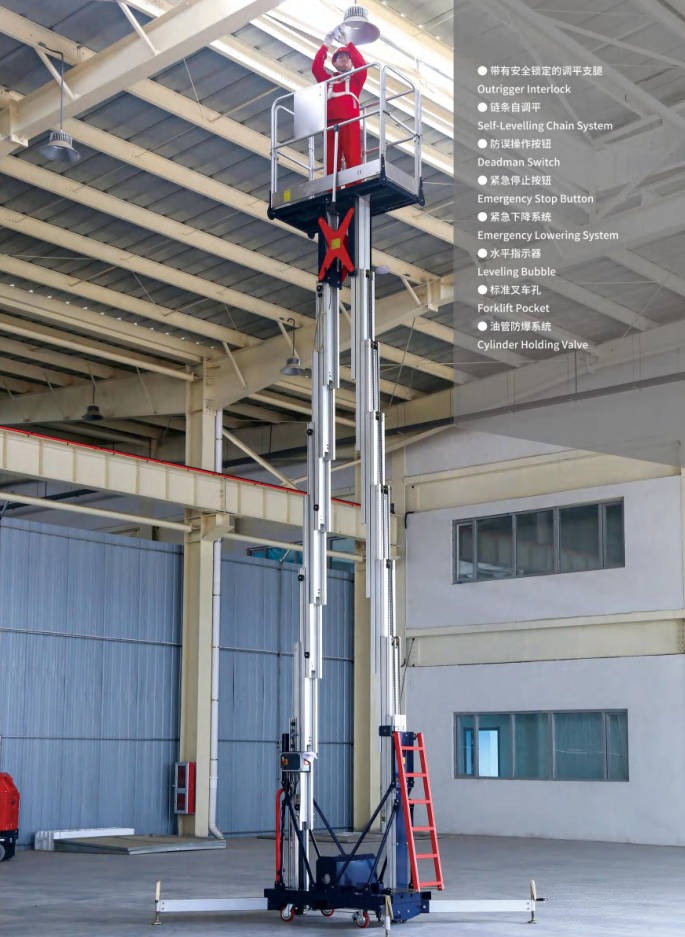
An aluminum vertical mast lift is a compact aerial work platform with a narrow body and a mast structure that raises the platform straight up. It is often chosen for one-person or light-duty tasks in places where space is limited.
On many indoor jobs, access is the real problem, not height. A maintenance team may need to pass through a standard doorway, enter a passenger elevator, move across polished flooring, or work between shelving and display areas. In those conditions, a compact mast lift is often the more practical choice.
Typical jobs include:
- changing ceiling lights in hotel corridors
- repairing signs in shopping centers
- servicing cameras and sensors in terminals
- light maintenance in libraries, gyms, and office buildings
Scissor Lift: Built for Platform Space and Productivity
A scissor lift raises the platform using a crossed support structure. Compared with a mast lift, it usually offers a bigger platform, higher capacity, and better support for jobs that require more tools, more materials, or longer working time at height.
This matters when the task is not just “reach and fix.” In a warehouse, for example, workers may need space for cartons, tools, cable reels, or a second person. In that case, the added platform room of a scissor lift can save repeated trips up and down.
Common uses include:
- indoor equipment installation
- inventory checks at height
- painting and ceiling work over larger sections
- electrical and mechanical work that needs more tools on the platform
Quick Comparison: Which Lift Fits Which Job?
The choice becomes easier when the buyer compares actual operating needs instead of only looking at lift height.
Side-by-Side Comparison Table
| Factor | Aluminum Vertical Mast Lift | Scissor Lift |
|---|---|---|
| Best for | Tight indoor spaces | Larger indoor work zones |
| Machine width | Narrower, easier through doors and aisles | Wider footprint |
| Platform space | Smaller | Larger |
| Typical operator setup | Often one person | Often one or two workers |
| Platform capacity | Lower | Higher |
| Floor pressure concern | Better for lighter floor-load areas | Depends on machine size |
| Repositioning style | Good for short, precise access tasks | Better for repeated travel in larger areas |
| Indoor finish sensitivity | Well suited to finished interiors | Also suitable, especially electric indoor types |
| Common job type | Light maintenance | Maintenance, installation, stock work |
That basic picture already explains why the two machines are often compared, but rarely interchangeable in every job.
When an Aluminum Vertical Mast Lift Is the Better Choice
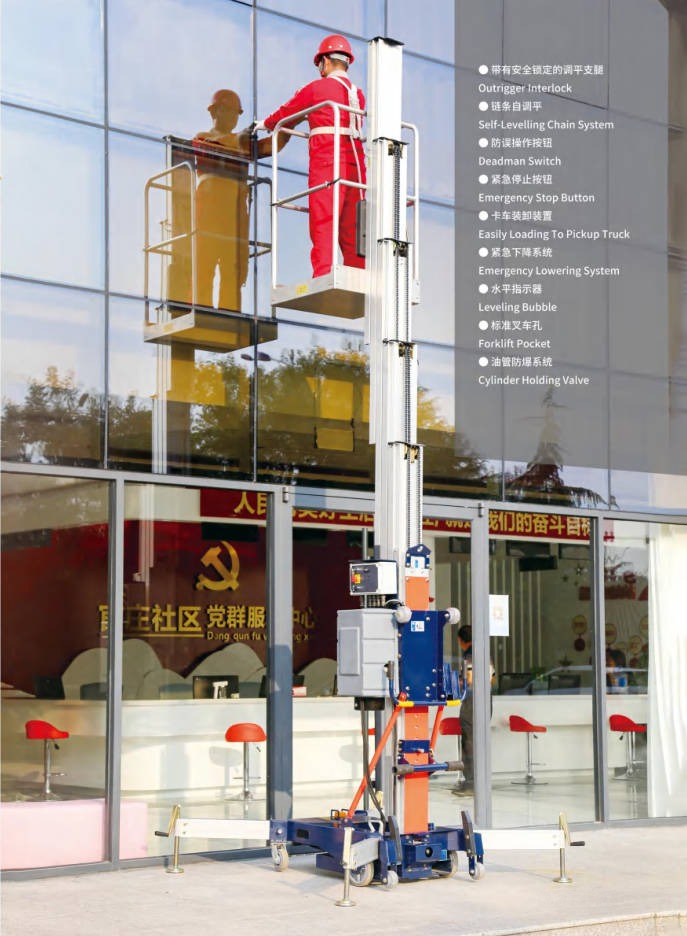
In many finished indoor environments, compactness matters more than platform size.
Best for Narrow Aisles, Doorways, and Finished Interiors
A vertical mast lift makes sense when the machine must move through narrow passages or work in areas with limited turning space. Think of a hotel passage that is just wide enough for housekeeping carts, or a retail aisle where displays cannot be moved every time maintenance is needed.
Because the structure is slimmer and lighter, this type of indoor aerial work platform is often preferred in:
- hotels
- hospitals
- schools
- shopping malls
- airports
- exhibition halls
For these sites, a bulky machine may create more disruption than the repair itself.
Better for Light Maintenance and One-Person Jobs
Many high-frequency maintenance tasks do not require a large deck. Replacing a lamp, checking a sprinkler head, fixing a sign bracket, adjusting a CCTV unit, or inspecting a ceiling panel are usually single-operator jobs with a small tool load.
In those cases, a compact aerial lift saves time in three ways:
- less effort to position the machine
- easier entry into tight work areas
- faster setup for short-duration tasks
That is why vertical mast lifts are often chosen by facility teams that handle multiple small jobs in one shift.
A Good Fit Where Floor Load Is a Concern
Some indoor spaces have flooring, mezzanines, or access routes where lower machine weight is a real purchasing factor. In older commercial buildings, finished lobbies, and upper-level service zones, that can influence the equipment decision as much as working height.
An aluminum-built mast lift is often attractive for these conditions because the structure is designed around low weight and easy handling. On product pages for this category, JinChengYu highlights lightweight aluminum construction, narrow access suitability, and use in hotels, terminals, and maintenance environments with floor-load limits.
When a Scissor Lift Is the Better Choice
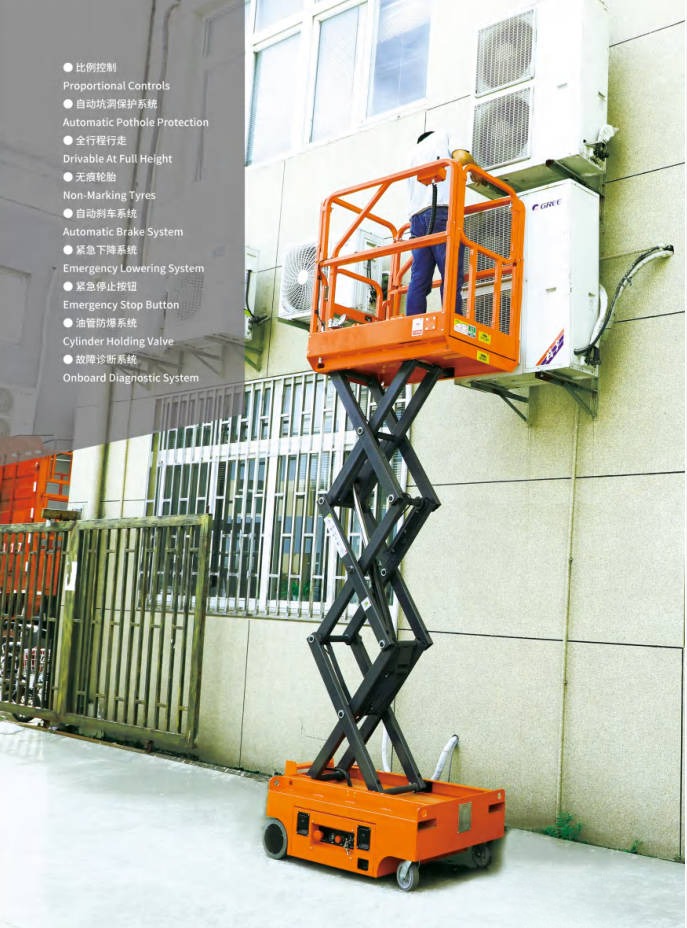
A scissor lift starts to make more sense when the work becomes heavier, wider, or more continuous.
Better for Jobs That Need More Platform Room
Some tasks need space, not just height. A worker installing cable trays, carrying several tool cases, or handling replacement materials will quickly feel the limit of a small platform.
A scissor lift helps when the platform must hold:
- more tools
- spare parts
- long work materials
- a second operator
- repeated loads during the same job
This is common in warehouses, distribution centers, shopping centers during fit-out, and large public buildings.
Stronger for Repetitive Work Across Large Areas
In a warehouse, maintenance work is rarely confined to one exact point. A team may inspect lights row by row, scan racking, or service equipment across a large floor. A self-propelled electric scissor lift is valuable here because it can travel efficiently around the work area and keep the operator productive over a longer shift.
Electric indoor scissor lifts are also favored in spaces that require low noise and clean operation. JinChengYu describes this type of platform as suited to airports, warehouses, and shopping malls, with features such as silent electric drive, non-marking tires, and an extension deck.
More Practical for Higher Platform Capacity
Capacity is one of the clearest dividing lines. If the task involves heavier tools, extra materials, or two workers, the scissor lift often wins by a wide margin.
A typical buyer should ask:
- How many people will be on the platform?
- How much tool weight is carried per trip?
- Does the job involve installation materials, not just hand tools?
- Will the task run for hours in the same zone?
If the answer is yes to most of these, a scissor lift is usually the safer and more efficient choice.
Real-World Job Scenarios
The most useful way to choose is to match the machine to the job, not the catalog.
Scenario 1: Hotel Corridor Lighting Repair
The team needs to replace downlights on several floors. The machine must enter elevators, pass through narrow hallways, and avoid damaging finished flooring.
Best choice: aluminum vertical mast lift
Scenario 2: Warehouse Inventory and Overhead Inspection
The operator needs to move through long aisles, stop often, work at height repeatedly, and carry scanners, tools, and replacement parts.
Best choice: electric scissor lift
Scenario 3: Shopping Mall Sign and Ceiling Maintenance
The work area is open, but customer pathways, display islands, and decorative flooring limit movement. The task changes from sign repair to sensor adjustment to light replacement.
Best choice: vertical mast lift for tighter sections; scissor lift for wider overnight work zones
Scenario 4: Airport or Terminal Indoor Service Work
Noise control, clean power, and non-marking travel matter. Some jobs need compact access near public areas, while others need more deck space in back-of-house service zones.
Best choice: depends on task frequency and load, but both machine types can play different roles in the same facility
What Buyers Should Check Before Making a Decision
By this point, the difference is clearer. The last step is buying based on operating reality, not brochure language.
Selection Checklist
| Question | If Yes, Lean Toward |
|---|---|
| Need to pass through standard doors or narrow aisles? | Vertical mast lift |
| Mostly one-person light maintenance? | Vertical mast lift |
| Need more platform room or higher load capacity? | Scissor lift |
| Work happens across a large indoor area all day? | Scissor lift |
| Floor load and building finish are major concerns? | Vertical mast lift |
| Need quiet electric indoor operation? | Scissor lift or electric mast lift, depending on space |
A buyer who answers these six questions honestly will usually narrow the choice quickly.
A Brief Look at JinChengYu FORKLIFT
Choosing the right supplier matters almost as much as choosing the right machine, especially for export buyers who need stable communication, product range, and after-sales coordination.
JinChengYu FORKLIFT is based in Qingdao and handles export business in materials handling, warehouse equipment, ground support equipment, and related machinery. Its website shows a broad product range that includes aerial work platforms as part of a wider equipment offering, along with case pages, contact support, and international sales coverage. The company presents itself as a supplier focused on overseas markets, quality inspection before shipment, and service support for global customers.
For buyers comparing an aluminum vertical mast lift and a scissor lift, that range is useful because the choice can be based on site needs rather than being pushed toward only one machine type.
Conclusion
The choice between an aluminum vertical mast lift and a scissor lift comes down to one simple rule. Buy for the job site, not just the lifting height.
If the work happens in narrow aisles, nice inside areas, elevators, hotel corridors, or low floor-load areas, a vertical mast lift is often the smarter fit. If the job needs more deck space, more platform capacity, and steady movement across larger indoor zones, a scissor lift usually makes more sense.
For facility managers, contractors, and equipment distributors, the best result comes from matching access width, platform load, work duration, and site layout before asking for a quotation. That approach leads to better uptime. It creates fewer workarounds. And it makes a much better buying decision.
FAQs
Is a vertical mast lift safer than a scissor lift?
Neither is “safer” in every case. Safety depends on using the right machine for the task, floor condition, load, and working area. A mast lift can be a better fit in tight indoor access zones. A scissor lift can be safer for jobs that need more platform space and load capacity.
Are electric scissor lifts suitable for indoor use?
Yes. Electric scissor lifts are widely used indoors because they are quieter and cleaner than engine-driven equipment. Non-marking tires also make them more suitable for finished floors.
Which is more cost-effective?
For short, frequent, light-duty access tasks, a vertical mast lift may deliver better value because it is compact and simple to position. For heavy-duty, repeated, higher-capacity indoor work, a scissor lift may offer better productivity per shift.
Is a vertical mast lift good for one-person jobs?
Yes. Compact mast lifts are commonly used for one-person setup and operation in indoor maintenance environments.
When should a buyer choose an electric scissor lift?
Choose it when the work needs more platform room. It also fits when more tools are on deck. More lifting capacity helps too. Or more time working at height in larger indoor areas works well.